
Your team is probably already feeling this shift.
A buyer opens ChatGPT, Perplexity, Gemini, or Claude and asks a high-intent question about your category. They aren't searching the way they did two years ago. They're asking for shortlists, comparisons, migration advice, and “best tools for” recommendations. Your brand may show up. A competitor may dominate the answer. An old positioning line from a review site may shape the entire response. And in most B2B SaaS teams, nobody can say with confidence what those systems are saying, how often they cite the company, or whether any of it turns into pipeline.
That's the new blind spot.
It exists at the same moment AI use is exploding. The AI market is projected to reach $407 billion by 2027, up from $86.9 billion in 2022, and over 75% of companies already use AI in marketing operations, according to Forbes Advisor's AI statistics roundup. That changes where brand perception gets formed. It also changes what marketing ops has to measure.
Traditional social listening won't solve this on its own. Neither will SEO rank trackers. Those systems were built for public posts, web traffic, and page rankings. They weren't built for AI-generated answers that summarize, rank, and frame brands before a buyer ever visits your site.
Table of Contents
- Introduction Your Brand's Invisible Conversations
- What Is AI Brand Monitoring Really
- Key Metrics That Matter for B2B SaaS
- How Citable Inc. Can Help
- Closing the Loop Connecting Mentions to Revenue
- Building Your AI Brand Monitoring Tech Stack
- Common Challenges and Practical Workflows
- Conclusion From Monitoring to Proactive Growth
Introduction Your Brand's Invisible Conversations
The most common version of this problem looks ordinary at first. Paid search is stable. Organic traffic is mixed. Branded search hasn't collapsed. Sales says deal quality feels inconsistent. Then someone on the team starts asking AI assistants the same questions buyers ask, and the pattern shows up immediately. Competitors are named directly. Your category is explained in language you didn't choose. Your product is missing from queries where it should obviously appear.
That's not just a visibility issue. It's a go-to-market issue.
In B2B SaaS, high-intent discovery is moving into environments you don't control. A prospect can ask for “best SOC 2 compliance tools for startups,” “top attribution software for B2B SaaS,” or “alternatives to legacy CRM reporting,” and get an answer that compresses months of category perception into a few paragraphs. If your team doesn't monitor those outputs, you're relying on chance to shape early consideration.
The black box problem for modern growth teams
Older brand monitoring programs were designed around public mentions, press coverage, review sites, and social channels. Those inputs still matter. But they don't tell you how an AI assistant stitches them together into a final answer. That synthesis layer is where a lot of category framing now happens.
A buyer doesn't need to click ten blue links anymore. They can get a vendor shortlist in one response.
Practical rule: If buyers can ask an AI assistant for a recommendation in your category, your brand already has an AI narrative. The question is whether your team can see it.
The challenge gets worse in companies with separate systems for demand gen, product marketing, SEO, paid media, and RevOps. One team may track rankings. Another watches social sentiment. Sales records objections in the CRM. None of that creates a unified view of what AI systems say about the brand or how those narratives influence revenue.
Why this matters now
This isn't a niche monitoring task for comms teams. It belongs inside the operating system of growth.
The practical shift is simple. AI brand monitoring means treating AI-generated responses as a measurable acquisition and perception channel. That includes your own brand, your competitors, your category terms, and the source ecosystem that trains or informs those answers. Once you start looking at it that way, the gap becomes obvious. Many organizations can tell you cost per lead by campaign. Very few can tell you whether improving AI visibility changed pipeline creation or CAC efficiency.
That's why basic mention counting isn't enough anymore. The main goal is to connect AI visibility to business outcomes.
What Is AI Brand Monitoring Really
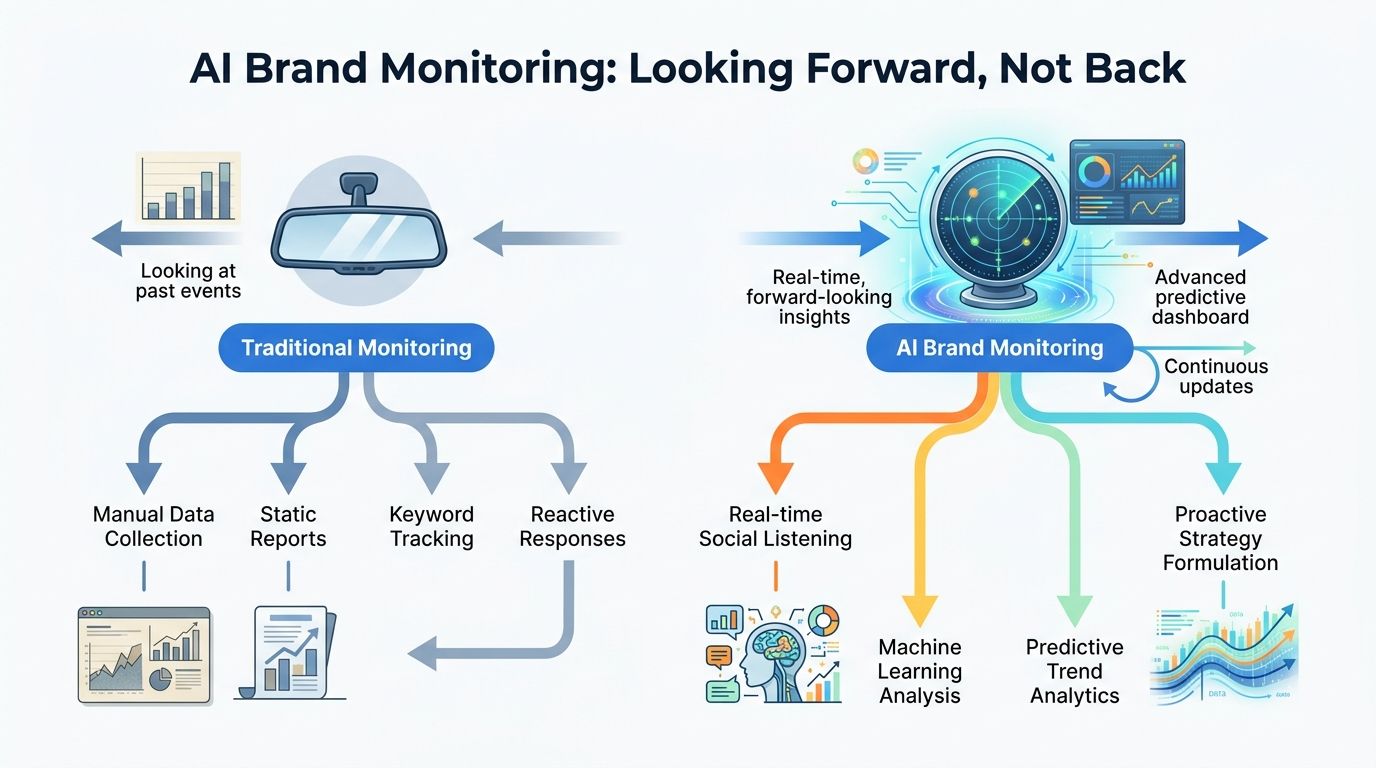
Think of traditional monitoring as a rearview mirror. You see what was said after it happened. You count volume, review spikes, and press mentions. That's useful, but it's limited.
AI brand monitoring works more like an active navigation system. It doesn't just show where your brand appeared. It helps teams understand what themes are forming, what sources are shaping AI outputs, and where the next narrative risk or opportunity is emerging.
Why older monitoring misses the real issue
The old model assumes a human analyst can keep up with the relevant conversation by tracking keywords and scanning channels. That breaks down fast when brand narratives are assembled from forum threads, review sites, editorial content, docs, comparison pages, social posts, and AI-generated summaries.
According to Sprout Social's explanation of AI brand monitoring, these systems aggregate large datasets from social media, news, forums, and review sites, then use natural language processing to group conversations into themes instantly. The practical benefit is early detection. Teams can spot trend shifts and intervene before issues escalate.
That thematic grouping is the important part. Raw mentions rarely tell you enough on their own.
For example, if your category appears in AI responses tied to “ease of implementation,” “security concerns,” and “pricing transparency,” those are three different commercial signals. Counting them together as “brand activity” hides what buyers are responding to.
What the system actually does
A strong AI brand monitoring setup usually performs five jobs at once:
- Collects source data from forums, review platforms, social platforms, editorial coverage, and AI-generated responses.
- Normalizes language so “best tool,” “top platform,” and “recommended software” can be analyzed in context.
- Clusters narratives into themes such as pricing, onboarding, integrations, customer support, or product fit.
- Scores visibility and sentiment across prompts, engines, competitors, and use cases.
- Routes action to the right owner, whether that's SEO, product marketing, RevOps, demand gen, or customer marketing.
Here's where teams get tripped up. They buy a monitoring tool, set alerts, and stop there. But alerts without operational ownership become dashboard furniture.
A better operating model looks like this:
| Monitoring output | Team that should act | Example response |
|---|---|---|
| Competitor dominates comparison prompts | Product marketing | Refresh comparison pages and proof points |
| Negative pricing framing appears in AI answers | Demand gen and sales enablement | Tighten pricing narrative and objection handling |
| Brand missing from implementation-related queries | Content and SEO | Publish implementation-focused assets |
| Source mix skews toward third-party discussions | Comms and customer marketing | Increase trusted editorial and customer proof content |
AI brand monitoring is useful when it changes decisions. If it only changes reporting, the program won't survive budget review.
This is also why the best teams don't treat AI brand monitoring as a PR side project. They treat it as a cross-functional input to revenue operations. The signal starts with visibility, but the value shows up when teams use it to shape content priorities, competitive positioning, and attribution models.
Key Metrics That Matter for B2B SaaS
Many teams start with the wrong scoreboard.
They track every mention equally, celebrate generic sentiment improvements, and send monthly reports full of charts nobody in finance asked for. That's not a measurement framework. That's activity wrapped in dashboards.
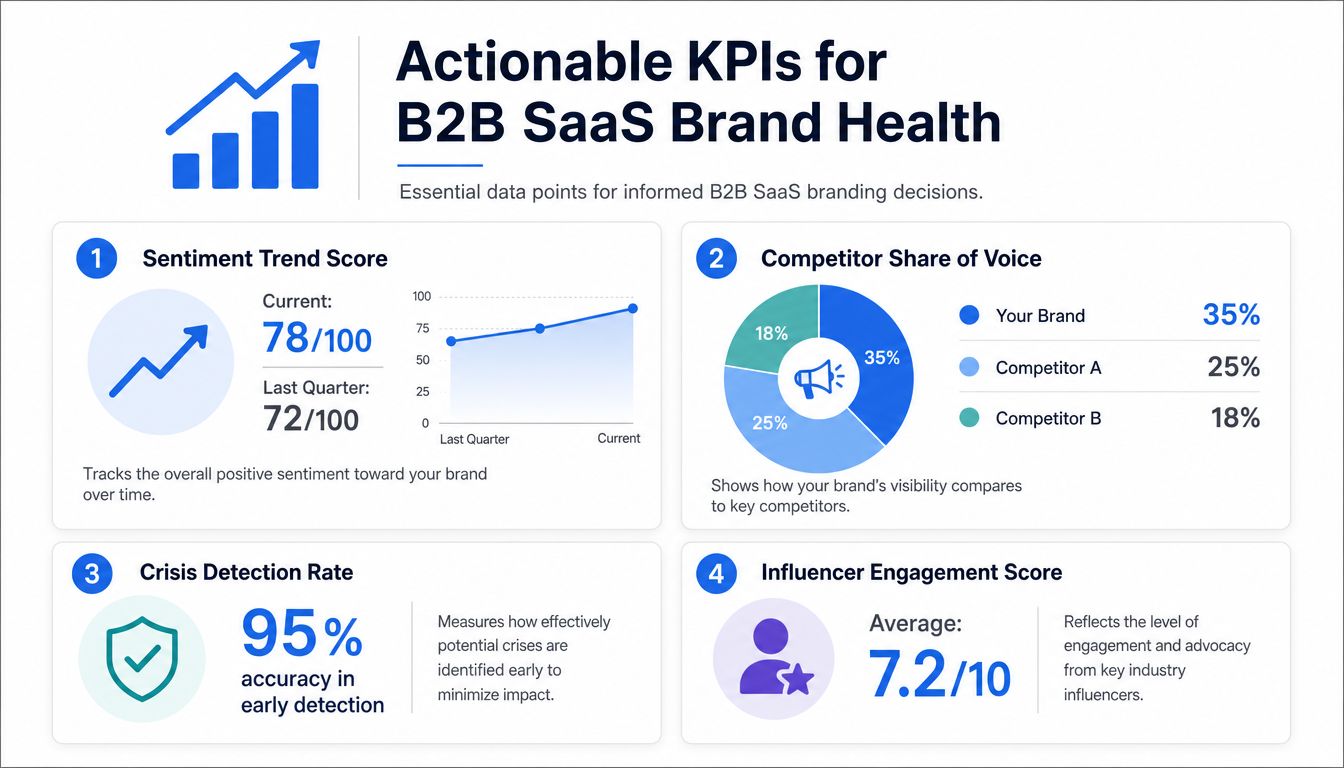
The baseline for AI brand monitoring is much simpler. Foxxr's overview of AI brand monitoring identifies three core KPIs: mention frequency, share of voice, and sentiment score. It also notes that tools such as Semrush's AI Visibility Toolkit show total citations in AI-generated answers, and that revenue increases from AI are most commonly reported in marketing and sales use cases. Those are the right starting points. They just need to be interpreted in a B2B SaaS context.
A visual summary helps when you're aligning leadership around a shared scoreboard.
The three baseline metrics
Mention frequency answers a basic question: how often does your brand appear in relevant AI outputs?
For B2B SaaS, relevance matters more than gross count. A mention in a vague educational answer is less valuable than a mention in a buyer-intent query such as “best tools for,” “top alternatives to,” or “which platform should I choose for.” If you don't segment by query intent, mention frequency quickly turns into a vanity metric.
Share of voice matters because buying decisions are comparative. Your brand isn't competing against silence. It's competing against the vendors AI assistants choose to surface in your category. This metric shows what share of relevant AI mentions your company owns versus competitors.
Sentiment score is useful when it captures framing, not just positive or negative language. In practice, B2B teams should read sentiment as positioning quality. Is the AI presenting your product as trusted, expensive, easy to use, enterprise-ready, hard to implement, or only suitable for small teams? That framing often shows up before a prospect ever talks to sales.
The embedded walkthrough below is helpful if you want to see how teams approach visibility tracking inside AI environments.
How finance teams should read them
A CFO doesn't care that your brand appeared more often last month unless that change correlates with business outcomes. So don't present these metrics in isolation.
Use them as leading indicators tied to a second layer of commercial questions:
- Mention frequency plus branded demand: Did visibility improve around high-intent prompts before increases in direct demo requests or branded search quality?
- Share of voice plus pipeline mix: When your brand gains AI share of voice against named competitors, do sourced opportunities include more competitive displacement or faster sales conversations?
- Sentiment plus win themes: When AI responses frame your product more clearly around your differentiators, do fewer deals stall on category confusion or feature fit?
This is also where board reporting gets cleaner. Instead of saying “our AI presence improved,” you can show that branded visibility is moving in the same direction as pipeline quality, CAC efficiency, and sales velocity. For teams building that reporting layer, a board-ready CAC, LTV, and payback dashboard gives a more useful template than a social listening summary ever will.
What to stop reporting
Drop the metrics that look busy but don't support action.
- Total unsegmented mentions: This mixes low-intent and high-intent contexts into one number.
- Average sentiment without narrative tags: A score without source context or theme analysis can hide major positioning problems.
- Platform-specific snapshots with no comparison set: Seeing one engine in isolation rarely tells you whether you're winning in category discovery.
The best AI brand monitoring KPI deck is short. If every metric can't be tied to a decision, remove it.
For B2B SaaS, the goal isn't to create a richer listening report. It's to create a tighter operating model.
How Citable Inc. Can Help
A specialized visibility platform fits best when your team has already accepted a basic truth: AI answers are now part of your acquisition surface, and you need to measure them directly.
Where a specialized visibility tool fits
That's where AI brand monitoring from Citable Inc. is useful. Citable focuses on how generative AI assistants cite and describe brands across high-intent queries. It audits persona-based answers, maps competitive intent environments, and gives teams a practical action plan for improving how AI systems understand and reference their company.
For product marketing teams, that matters because AI output often exposes unclear differentiation. For agencies, it's a way to audit multiple clients against the same GEO framework. For PLG teams, it helps connect what AI says about the product to content gaps, missing proof, and weak source coverage across site content, editorial mentions, community discussions, and video.
What it still will not solve alone
This is the trade-off. A visibility tool can tell you whether your brand is cited, where it's cited, how competitors appear, and how AI assistants frame the category. That's valuable. But visibility alone still won't answer the revenue question.
If your CEO asks whether stronger AI presence lowered CAC, improved ROAS, or influenced closed-won pipeline, a GEO dashboard by itself won't close that loop. You still need attribution, CRM alignment, and revenue reporting that connects early discovery signals to downstream outcomes.
That's why the right way to evaluate these tools isn't “Does this replace SEO software?” It's “Does this give us a reliable AI visibility layer that can feed a broader measurement system?” When the answer is yes, the tool earns its place.
Closing the Loop Connecting Mentions to Revenue
At this point, most AI brand monitoring programs stall.
A team proves that the company is showing up in more AI answers. Leadership nods. Product marketing updates messaging. SEO publishes new comparison pages. Then the next question comes. Did any of this create revenue?
Usually, nobody can answer.
The attribution gap that breaks most programs
Sentaiment's analysis of AI brand monitoring in 2025 captures the core problem well: there's a critical gap between AI visibility metrics like mentions and sentiment, and actual revenue outcomes like pipeline, CAC, and ROAS. Teams often know whether an AI system mentioned them, but not whether that mention converted a lead or influenced lifetime value.
That's the gap CFOs care about.
If your monitoring program ends at “we appeared in Perplexity more often this month,” you've built an awareness dashboard, not a growth system. In B2B SaaS, especially with long sales cycles and mixed sales-led plus product-led motion, you need a way to connect upstream visibility signals to downstream account behavior.
A practical closed-loop data flow
A workable setup doesn't need to be fancy. It does need to be disciplined.
Start with the source layer. That includes AI visibility data from tools that track citations, share of voice, source influence, and sentiment framing across relevant prompts and engines. Organize this by prompt cluster, competitor set, persona, and buying stage. Don't dump it into one generic bucket called “AI.”
Then create an identity and event layer across your owned properties. First-party tracking, server-side events, and CRM identifiers matter here because AI-influenced journeys often look indirect. A buyer may discover you in an AI answer, visit later through direct traffic, come back from branded search, join a demo, and convert after several touches. If your data model only rewards the last click, AI visibility will disappear from reporting.
A practical flow usually looks like this:
- Capture AI visibility signals by prompt, engine, brand, competitor, and source context.
- Map those signals to pages and themes on your site, such as integrations, implementation, security, pricing, or alternatives.
- Track visitor and account behavior with first-party web events, form activity, signup milestones, and CRM progression.
- Tie contacts and accounts to revenue outcomes in Salesforce, HubSpot, Stripe, or your warehouse.
- Analyze correlation and influence between AI visibility changes and pipeline, CAC, ROAS, and closed-won revenue.
Here, attribution discipline matters more than perfect certainty. You're not trying to prove that one AI mention single-handedly caused a contract. You're trying to measure whether improved AI visibility is showing up in the funnel where it should.
A closed-loop model doesn't need to assign total credit to AI. It needs to show whether AI visibility is influencing the path to revenue in a trustworthy way.
For teams trying to operationalize that handoff between marketing data and revenue systems, this guide on how to connect marketing to revenue is the right type of blueprint. The important point is the architecture. Visibility data has to join customer journey data, not sit beside it.
The KPIs a CFO will actually care about
Once the data flow is in place, the conversation gets sharper.
Instead of reporting “AI citations increased,” report questions such as:
| CFO question | Useful operating metric |
|---|---|
| Are we creating more efficient demand? | CAC trend for accounts influenced by AI-visible themes |
| Is awareness turning into pipeline? | Pipeline creation tied to query clusters where visibility improved |
| Are we winning better-fit customers? | Closed-won mix and expansion pattern from AI-influenced accounts |
| Are our programs improving spend efficiency? | ROAS movement when AI visibility and campaign targeting align |
There are trade-offs here.
What works: prompt-level analysis, account-based journey tracking, CRM stage mapping, and strong taxonomy.
What doesn't: trying to force AI into a simplistic last-click model, measuring all prompts as equal, or reporting visibility with no revenue context.
In practice, the cleanest programs usually start narrow. Pick one product line, one competitor set, one segment, and one set of buying-intent prompts. Measure visibility. Map it to owned content. Track influenced accounts through the CRM. Then expand.
That's how AI brand monitoring stops being interesting and starts becoming accountable.
Building Your AI Brand Monitoring Tech Stack
The stack shouldn't start with a dashboard. It should start with a question: what decision are you trying to improve?
If the answer is “we want to know whether AI assistants mention us,” you need one class of tools. If the answer is “we want to know whether AI visibility improves pipeline efficiency,” you need a more complete system.
The core stack layers
A solid stack usually has four layers.
First, the collection layer gathers source signals from AI assistants, public web content, review platforms, communities, forums, and owned channels. The important change in this market is that AI monitoring tools now track generative assistants directly. As Siftly explains in its AI brand monitoring overview, modern systems prioritize visibility within generative AI assistants by crawling AI UIs and using APIs to capture citation frequency, share of voice, and positional ranking. That also helps teams detect competitor displacement and understand whether their brand is framed positively, neutrally, or negatively.
Second, the analysis layer. Here, tools classify sentiment, group prompts by intent, identify source patterns, and benchmark your brand against competitors. The best setups also let you filter by persona, location, product line, or category cluster.
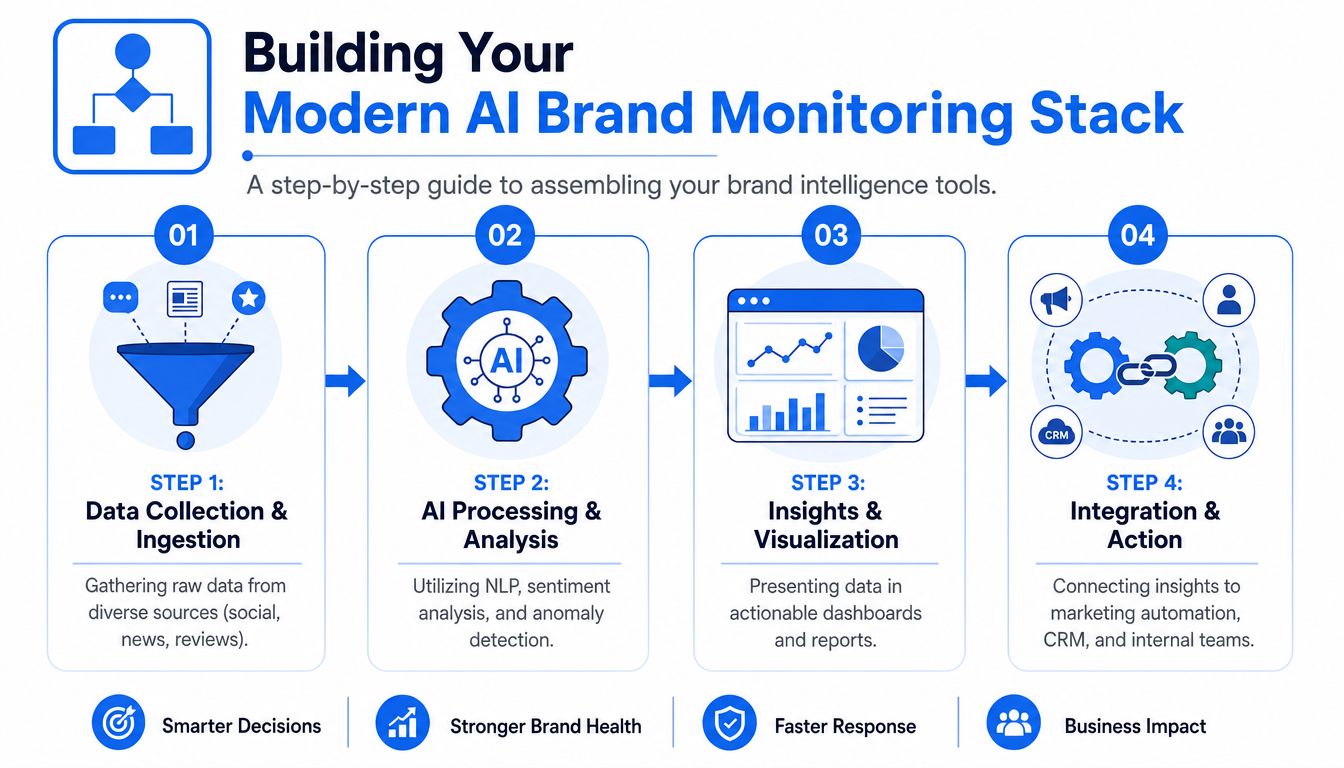
Third, the system-of-record layer. This is your CRM, product analytics, billing data, or warehouse. In most B2B SaaS teams, that means HubSpot or Salesforce for pipeline and stage progression, plus product and subscription data where needed.
Fourth, the activation layer. In this layer, insights trigger action. Content gets updated. Paid audiences shift. Sales enablement receives fresh objection handling. Customer marketing builds proof around the themes that AI systems already surface.
If you want a survey of category tools before choosing a stack, this roundup of AI brand visibility tracking tools is a useful starting point.
What good implementation looks like
The mistake I see most often is overbuilding before the taxonomy is stable. Teams ingest everything, then realize six weeks later that nobody agreed on prompt categories, source tiers, or naming conventions.
Start smaller.
- Choose a prompt set: Focus on high-intent category, alternative, comparison, and use-case prompts.
- Build a source taxonomy: Separate editorial, review, community, owned, partner, and competitor-owned sources.
- Tag business themes: Pricing, integrations, implementation, support, security, reporting, onboarding, and ROI tend to matter in B2B SaaS.
- Define ownership: Product marketing handles narrative gaps. SEO handles content coverage. RevOps owns CRM mapping. Paid media uses the downstream signals for targeting and exclusions.
A simple ownership model beats a complex but vague architecture every time.
Common objections that slow teams down
The usual objections are reasonable.
“The data is noisy.” Yes, it is. AI outputs vary by prompt wording, location, account history, and model changes. That's why you should focus on repeated prompt sets and trend direction, not one-off screenshots.
“We can't see inside the model.” Also true. You won't get perfect explainability. But you can still monitor outputs, source citations, and theme consistency at a level that's operationally useful.
“This sounds like extra work for an already stretched team.” It can be, if you treat it as a standalone program. It gets easier when you plug it into workflows teams already own, like content planning, sales enablement, CRM reporting, and paid optimization.
A good stack reduces manual checking. A bad stack creates another dashboard nobody trusts.
Common Challenges and Practical Workflows
No team gets this perfect on the first pass. The useful question isn't whether AI brand monitoring is messy. It is. The useful question is whether the mess is manageable enough to produce action.
The problems teams run into fast
The first problem is data accuracy. AI systems don't return identical answers every time, and source attribution can be inconsistent. If your team reacts to every single fluctuation, you'll waste time chasing noise.
The second problem is the black box effect. You can see the answer but not the full internal weighting behind it. That makes some marketers uncomfortable because they're used to cleaner ranking logic or more direct ad platform feedback.
The third is operational drift. Teams launch the program with energy, then ownership gets fuzzy. Product marketing thinks SEO owns it. SEO thinks RevOps should report it. RevOps thinks brand should handle it. Nobody is wrong, but nobody is accountable either.
The challenge-solution trade-off is easier to grasp visually.
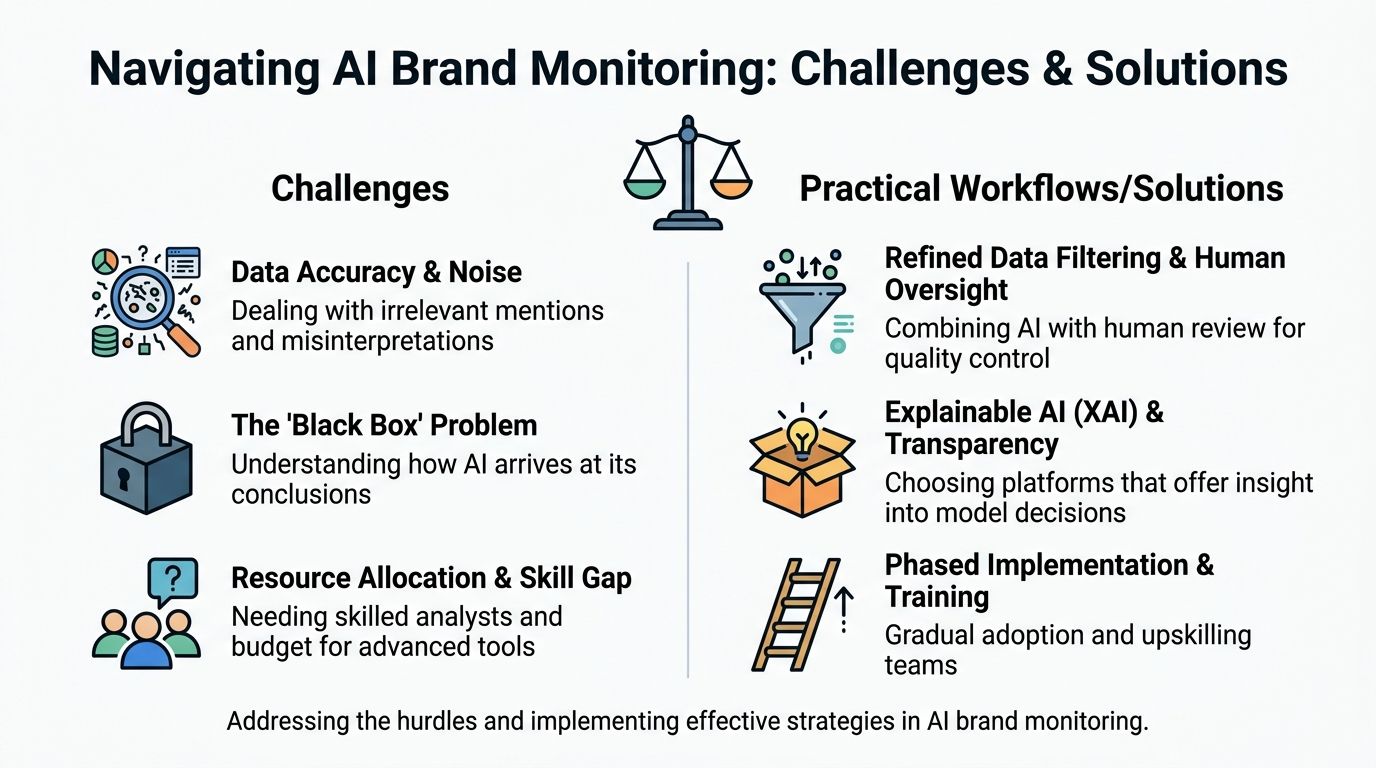
The practical fixes are less glamorous than the tooling:
- Use fixed prompt libraries instead of ad hoc testing.
- Review trend lines weekly and examples daily only when alerts trigger.
- Keep human review in the loop for sentiment and competitive framing.
- Assign one DRI per workflow even if multiple teams contribute.
Treat AI visibility data like directional market intelligence. It's most useful when paired with disciplined review and downstream business context.
Three workflows that are worth operationalizing
Workflow one: competitor displacement detection
If AI assistants repeatedly cite competitors for use cases you know you serve well, route those findings to product marketing and SEO together. Product marketing sharpens differentiated claims. SEO and content teams publish assets that make those claims easier for AI systems to cite. Sales enablement gets updated battlecards based on the same themes.
Workflow two: narrative gap repair
When sentiment is neutral but the framing is weak, the issue usually isn't negativity. It's ambiguity. Buyers see your brand, but they don't understand why it wins. In that case, audit the source mix. If AI assistants rely heavily on thin third-party summaries, improve first-party explainers, customer proof, comparison pages, and implementation content.
Workflow three: revenue validation loop
This is a workflow frequently skipped. Start with a set of prompts tied to one commercial theme, such as analytics, security, or onboarding. Track visibility and framing over time. Then compare that movement against influenced opportunities, demo quality, sales-call themes, and closed-won patterns in the CRM. If the narrative improves but pipeline quality doesn't, the issue may be traffic quality, conversion experience, or sales qualification rather than AI visibility itself.
At this stage, AI brand monitoring becomes more than defensive reputation management. It becomes a planning input for growth.
Conclusion From Monitoring to Proactive Growth
AI brand monitoring matters because buyer research has changed. Brand perception now forms inside AI-generated answers that many teams still don't track well. If your company is only watching social mentions, reviews, and organic rankings, you're missing one of the places where shortlists are increasingly built.
But simple visibility isn't the finish line.
Mention frequency, share of voice, and sentiment are useful because they show where your brand appears and how it's framed. They become strategically important only when they connect to pipeline, CAC, ROAS, and revenue quality. That's the shift from monitoring to management. And from management to growth.
The best programs are operational, not performative. They use a fixed prompt set. They define ownership. They connect AI visibility data to CRM stages, product signals, and revenue reporting. They focus on trend direction and business outcomes instead of trying to create perfect certainty from a moving AI environment.
That's also why this category is heading toward closed-loop measurement. Teams don't need another dashboard full of mentions. They need a system that can show whether stronger AI visibility changes what the business cares about.
If you want to turn AI visibility into accountable revenue reporting, the next step is pairing monitoring with attribution. Cometly helps B2B SaaS teams connect marketing, sales, and product data from first touch to closed-won, so AI-driven discovery can be measured against the outcomes your CFO tracks.

Previous Article
Document Analysis for B2B SaaS: Unlock Business InsightsNext Article
AI Search Optimization for B2B Growth 2026