
Search no longer starts and ends with a blue link. Buyers ask a question, an AI layer assembles an answer, and the website visit often never happens. That shift is already large enough to change how B2B SaaS teams should think about discovery. AI search traffic has increased by 527% year-over-year, Google AI Overviews reach 2 billion monthly users globally, and the zero-click rate climbs to 83% when AI Overviews are present, according to Semrush's AI SEO statistics roundup.
That creates a hard problem for growth teams. Visibility still matters, but clicks no longer tell the full story. A prospect can read your pricing explanation, implementation guidance, or product positioning inside an AI answer, then come back later through direct traffic, branded search, or a paid retargeting ad. If your measurement model only credits the last click, AI search looks weaker than it really is.
Most advice on AI search optimization stops at “get cited.” That's incomplete. B2B teams need a system that improves inclusion in AI answers and ties that influence to pipeline. If you're evaluating the stack around visibility itself, this list of AI optimization tools for visibility is a useful companion.
Table of Contents
- Introduction The New Reality of Search
- Redefining Search Goals for the AI Era
- Building Your Technical and Content Foundation
- How Outrank Can Help
- Choosing Models and Indexing for On-Site AI Search
- Designing for Discovery and User Engagement
- Closing the Loop with Attribution and Ad Optimization
- Conclusion From Visibility to Verifiable Impact
Introduction The New Reality of Search
The old search model was simple. Rank, earn the click, measure the session, optimize the conversion path. That model still matters, but it no longer captures how buyers discover software.
A growing share of search behavior now ends on the results page itself. AI systems summarize, compare, and recommend before a user ever lands on your site. For B2B SaaS, that changes the top of funnel from “website visit” to “answer visibility.” It also changes the job of content. Your page isn't only trying to persuade a human reader. It's also trying to become a reliable source fragment that an AI system can quote or synthesize.
The teams that adapt fastest usually make one mental shift first. They stop treating AI search optimization as a side project owned by SEO and start treating it like a revenue channel with a different set of touchpoints.
Practical rule: If a prospect can be influenced before the click, your attribution model has to start before the click too.
That's why the primary challenge isn't only inclusion in AI answers. It's proving business impact when influence appears earlier, spreads across channels, and often shows up later as branded demand, demo requests, or higher conversion rates from already-educated buyers.
Redefining Search Goals for the AI Era
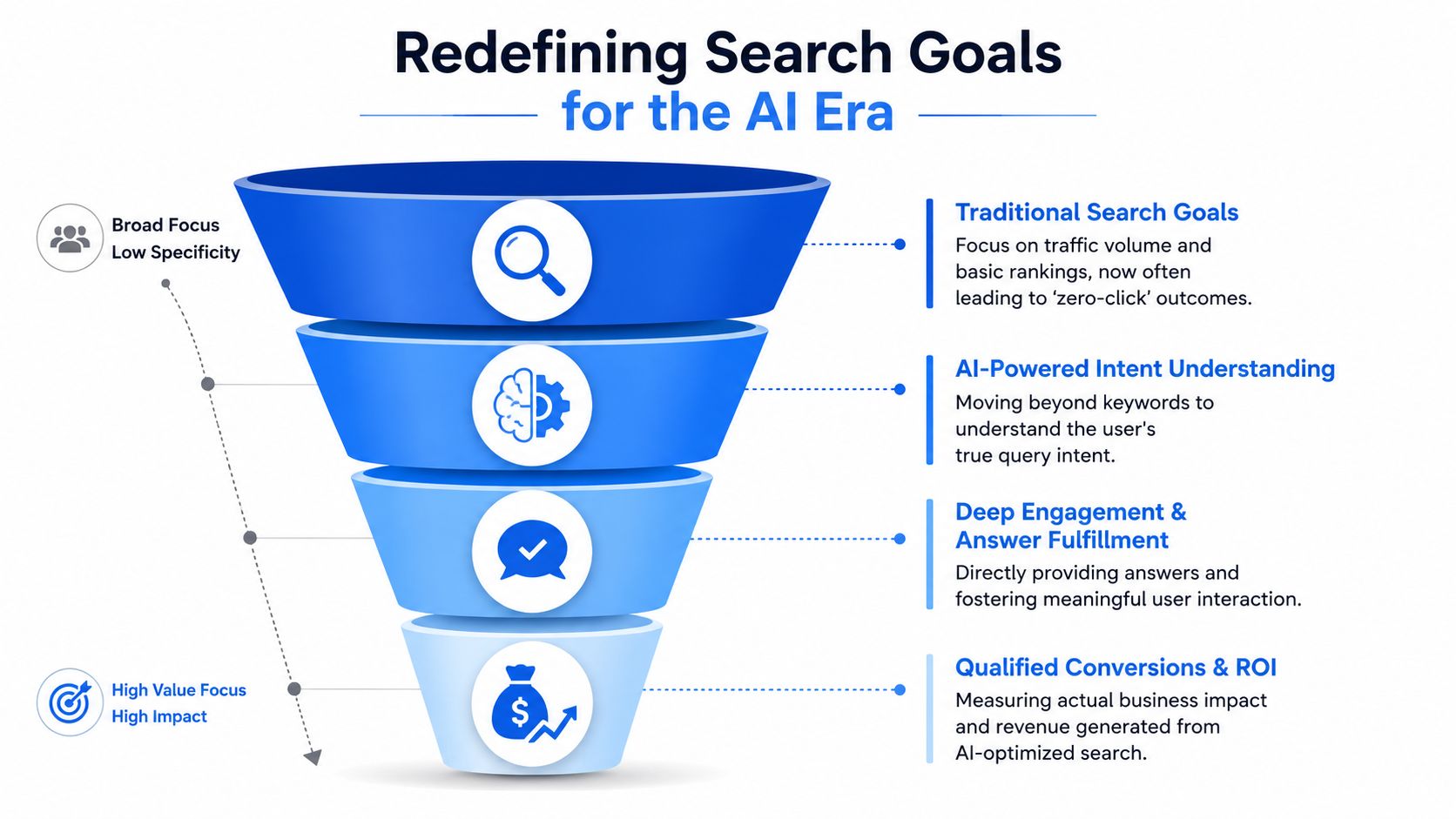
The first mistake teams make is keeping the same scorecard. If the dashboard still centers on sessions, top-line organic traffic, and rank snapshots, it will miss what AI search is changing.
The zero-click phenomenon now affects 60% of searches, and only 16% of brands systematically track AI search performance, according to Olive & Company's analysis of AI search optimization. That gap is why many teams feel AI search matters but can't show where it affects pipeline.
Why traffic is a weaker KPI
Traffic still has value. It just isn't sufficient.
When a buyer asks, “How long does implementation take?” and an AI answer cites your guide, your brand has shaped the evaluation process even if that user never clicks. The influence may appear later when that same account searches your company name, responds to a sales email, or converts from a comparison page.
That's why top-of-funnel volume can become a vanity metric in AI-heavy search environments. More visits don't always mean more commercial impact. In many B2B SaaS categories, fewer visitors with stronger intent are worth more than broad informational traffic that never turns into pipeline.
A more durable way to think about search now is this:
| Old goal | Better AI-era goal |
|---|---|
| Maximize visits | Maximize qualified discovery |
| Win generic rankings | Become the cited answer |
| Track pageviews | Track influenced opportunities |
| Publish at volume | Publish around buyer decisions |
What to measure instead
The right KPI set looks different because buyer influence now starts earlier and hides inside blended journeys.
Use a scorecard that includes:
- Brand presence in AI answers: Track whether your company, product, and experts appear when buyers ask category, comparison, and implementation questions.
- Citation frequency by topic: Group prompts by use case, pain point, competitor comparison, integration, onboarding, and pricing logic.
- Assisted branded demand: Watch for growth in branded search, direct visits, demo requests, and sales conversations that reference concepts taught in your content.
- Influenced conversions: Look for accounts that first encountered your message in an AI-driven discovery path and converted later through another channel.
- Content utility at mid and bottom funnel: Measure how often implementation guides, migration pages, help docs, and integration explainers contribute to conversions.
Teams that stay fixated on visit volume usually underinvest in the pages buyers actually use to make decisions.
This changes editorial priorities. Broad “what is” articles still have a role, but they can't dominate the roadmap. AI systems often prefer content that resolves specific questions with concrete structure, especially in B2B categories where buyers need practical guidance, not generic summaries.
The most useful content types tend to be:
- Implementation guides that answer process questions clearly.
- Comparison pages that explain trade-offs without hedging.
- Integration documentation that reduces perceived risk.
- Troubleshooting content that proves product maturity.
- Expert-authored explainers that add point of view instead of paraphrasing common knowledge.
When teams redefine success this way, attribution stops being optional. It becomes the operating system for AI search optimization.
Building Your Technical and Content Foundation
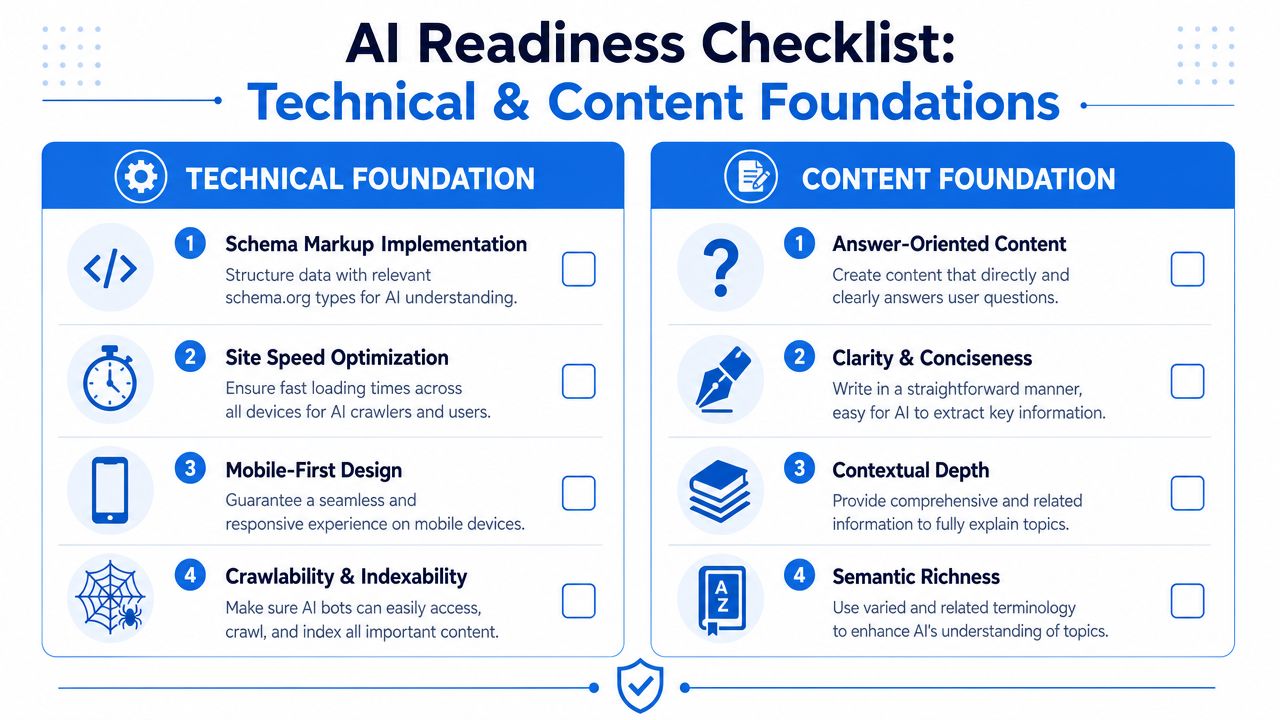
Many teams want a shortcut for AI visibility. There isn't one. The pages that get selected most often usually sit on a clean technical base and use formatting that machines can parse without guesswork.
AI search optimization requires page load times under 3 seconds, short paragraphs, and descriptive subheadings. Research also found that 88.1% of queries triggering AI Overviews are informational, and only 46% of documents cited in AI Overviews already ranked in the top organic results, according to MonsterInsights' guide to AI search engine optimization.
Technical requirements that change outcomes
The fastest way to lose visibility is to publish strong content on pages that are slow, bloated, or hard to crawl.
For B2B SaaS sites, the technical checklist usually starts here:
- Keep pages fast: Aim for load times under 3 seconds. Heavy JS, oversized images, and layered tracking scripts often create the drag.
- Use modern image formats: WebP and AVIF help reduce weight without wrecking quality.
- Enable browser caching: Repeat visitors and crawlers benefit when assets don't need to be fetched from scratch.
- Deploy a CDN: Global delivery matters when your site serves buyers, bots, and documentation users across regions.
- Protect crawl paths: Important pages should be easy to discover through internal links, not buried behind app-like navigation.
A lot of AI search advice pretends traditional SEO is outdated. In practice, foundational SEO still carries the load. Strong internal linking, clean metadata, useful titles, and logical page hierarchy all make it easier for search engines and AI systems to interpret what a page is for.
Here's a simple diagnostic I use with SaaS teams:
| If this is happening | Check this first |
|---|---|
| Blog posts rank but rarely get cited | Heading structure and answer formatting |
| Docs are useful but barely visible | Crawlability and internal linking from commercial pages |
| Product pages attract branded traffic only | Entity clarity, use cases, and schema support |
| Pages are indexed but weak in AI answers | Speed, structure, and explicit question resolution |
A short technical walkthrough helps teams spot obvious gaps before they rewrite a single article:
Content formats AI systems can actually use
A surprising amount of content fails because it's written like a brochure.
AI systems work better with pages that expose clear units of meaning. That means short paragraphs, useful headings, and sections that answer one thing at a time. If a paragraph tries to define the problem, compare vendors, explain implementation, and add product messaging all at once, extraction gets harder.
The structure that tends to work best is straightforward:
- Lead with the answer: Put the direct response near the top of the section.
- Use descriptive headings: “How implementation works” beats “Learn more.”
- Break processes into steps: Numbered lists help both readers and parsers.
- Add FAQs where they're natural: Not as filler, but where buyers have recurring objections.
- Keep examples concrete: SaaS buyers respond to workflows, integrations, migration concerns, and handoff details.
If your content only makes sense when read top to bottom, it's harder for AI systems to extract the right part.
One practical edit improves many pages: rewrite bloated intros into short answer-first openings. A help article that begins with company context and product philosophy often underperforms a version that starts with “To connect X to Y, complete these steps.”
Schema and page types for B2B SaaS
Structured data helps reduce ambiguity. It doesn't rescue weak content, but it gives search systems cleaner signals.
For most B2B SaaS sites, the most useful schema types are:
- FAQ schema on genuine question-and-answer sections
- HowTo schema on process-driven tutorials where appropriate
- Author schema for expert-led educational content
- Organization schema on core company and product pages
The biggest mistake is mismatch. If schema says one thing and the visible page says another, trust drops. Keep the structured data aligned with the rendered content.
For page planning, I'd prioritize these assets first:
- Product use-case pages that map features to buyer outcomes.
- Implementation and migration pages that reduce operational anxiety.
- Integration pages with plain-language explanations.
- Help center articles written for real customer questions.
- Comparison and alternative pages that address active evaluation.
That mix gives you a better chance of being cited across discovery, evaluation, and post-click education. It also produces content your sales team can use.
How Outrank Can Help
Outrank fits teams that need more output without turning content operations into a manual publishing treadmill. Its core value is automation across planning, writing, publishing, and link support, which matters when your AI search optimization program depends on consistent topic coverage rather than occasional big content projects.
The platform analyzes your niche, competitors, and audience, then builds a 30-day publishing plan around high-potential keyword opportunities. From there it generates on-brand articles with metadata, internal and external links, AI-generated images, and relevant YouTube embeds, then pushes them directly into systems like WordPress, Webflow, Shopify, Notion, Wix, Framer, Ghost, or custom workflows.
Where it fits best
Outrank is a strong fit in a few situations.
- Lean growth teams: If one person owns SEO, content, and site updates, automation can keep publishing moving.
- Agencies with multiple client sites: A shared dashboard and repeatable workflows reduce coordination overhead.
- Companies expanding topic coverage: It's useful when you need breadth across integrations, comparisons, pain-point pages, and educational content.
- International programs: Support for many languages helps teams localize faster without rebuilding the process each time.
Its backlink network is also relevant because AI visibility still tends to build on traditional search authority. If you want a practical complement to this article, Outrank's guide to AI search optimization strategies is worth reading for link-building and visibility workflows.
What to watch before you adopt it
Automation isn't a substitute for judgment. The teams that get the most value from a platform like Outrank still define positioning, approve topic priorities, and tighten claims so pages sound like a real operator wrote them.
I'd use it to accelerate production, internal linking, and publishing consistency. I wouldn't hand it your category narrative and hope it invents one for you. In B2B SaaS, the sharpest gains usually come from combining automation with strong editorial control over product truth, customer language, and commercial intent.
Choosing Models and Indexing for On-Site AI Search
External AI engines matter, but many B2B teams miss a second opportunity. They can bring AI search onto their own site, help center, or product surface so buyers find answers without bouncing.
That doesn't replace search engine visibility. It complements it. The strongest programs still build on standard SEO, because traditional search currently drives over 60% more traffic than AI platforms and high Google rankings overlap heavily with AI visibility, as noted in this analysis on AI search strategy.

What embeddings and indexing actually do
At a practical level, embeddings turn content into a numerical representation of meaning. That lets a search system retrieve relevant information based on semantic similarity, not only exact keyword matches.
A vector index stores those representations so the system can quickly find the closest content chunks when a user asks a question. That's useful on a SaaS site because real users rarely search with your exact page titles. They ask messier things like “Can I route leads from paid social into Salesforce without duplicates?” A semantic system has a better chance of matching that query to docs, integration pages, and setup guides that use different wording.
You don't need to explain vectors to your buyers. You do need to make three implementation decisions:
- How to chunk content: Too large and answers become vague. Too small and context gets lost.
- What to index: Blog posts, docs, release notes, academy content, product marketing pages, and support articles shouldn't all be treated the same.
- How often to refresh: Fast-moving docs and pricing-adjacent pages need tighter update discipline than evergreen thought leadership.
How to choose a practical stack
Decisions should be based on operational fit, not abstract model benchmarks.
A useful selection framework looks like this:
| Decision area | Trade-off to evaluate |
|---|---|
| Managed API model | Faster setup, simpler maintenance, less infrastructure control |
| Open-source model | More flexibility, heavier ops burden |
| Hosted vector database | Easier scaling, recurring vendor dependence |
| Self-managed index | More control, more engineering work |
| Large content chunks | Better context, weaker precision |
| Small content chunks | Better precision, more retrieval noise |
For many SaaS companies, the right first version is boring on purpose. Use a reliable embedding provider, index your help center and high-intent commercial pages first, and set strict source display rules so answers cite the pages they came from.
If your team is comparing vendors for observability and workflow around this area, a directory of AI search monitoring tools can help map the stack around visibility, tracking, and performance review.
Where on-site AI search creates business value
On-site AI search works best where users have questions with real buying or activation intent.
Strong starting points include:
- Help centers where users need fast, accurate answers
- Integration libraries where prospects compare setup complexity
- Resource hubs where buyers research workflows before requesting a demo
- In-app search where users need feature discovery or troubleshooting
The best internal AI search experiences don't try to sound clever. They help users resolve the next decision quickly and show where the answer came from.
That source visibility matters. In B2B, trust often comes from seeing the original doc, not just reading the summary. A generated answer without clear citation can feel convenient but fragile.
Designing for Discovery and User Engagement
A strong retrieval layer can still produce a weak experience if the interface creates friction. Buyers don't care that your semantic search is elegant if the search box feels unpredictable or the results don't help them move forward.
Interface patterns that reduce friction
The search interface should invite natural language without forcing users into it. A simple prompt such as “Ask about integrations, setup, pricing logic, or troubleshooting” does more than a generic search placeholder because it teaches the system's range.
A few patterns consistently improve usability:
- Accept conversational queries: Let users ask full questions, not only keywords.
- Show source pages clearly: Every answer should point back to docs, articles, or product pages.
- Preserve scannability: Summaries help, but users still need visible titles, categories, and result types.
- Offer next questions: Suggested follow-ups keep users moving deeper into relevant content.
- Handle uncertainty transparently: If confidence is low, show likely sources instead of bluffing with a polished answer.
Buyers also need context about content type. A migration guide, a product page, and a changelog entry can all match the same query, but they serve different jobs. Good interfaces label those distinctions so users can choose the right path.
Ranking and guidance inside your own results
Internal ranking should reflect business priorities without becoming self-serving. If every query pushes users toward sales pages, trust drops fast. If every result favors old educational content, commercial intent gets lost.
I like a blended ranking model that weighs:
- Topical relevance to the query
- Freshness when the topic changes often
- Content authority based on page type and editorial confidence
- Business value when several results are similarly relevant
That lets you prioritize a current implementation guide over an outdated blog post, while still surfacing the older article if it contains useful background.
A practical pattern for B2B SaaS is to rank by journey stage. For broad queries, lead with educational explainers. For action-oriented queries, feature docs, integrations, and setup content. For vendor-comparison queries, surface commercial pages that answer trade-offs directly.
One more design choice matters: make room for exploration. Search shouldn't act like a dead end. It should recommend adjacent content such as a comparison page after a setup article, or a case-study-style resource after a troubleshooting query. That's how search becomes an engagement system, not just a utility.
Closing the Loop with Attribution and Ad Optimization
Most AI search programs falter. Teams can improve visibility, but they can't show how that visibility affects revenue because the journey is fragmented and the first touch often stays invisible inside an AI answer.
That gap is larger than most dashboards suggest. While 50% of consumers use AI-powered search, only 16% of brands systematically track its performance, creating a measurement blind spot that is especially painful in B2B SaaS, according to McKinsey's analysis of AI search as the new front door to the internet.
How to instrument AI search influence
The first job is to separate AI-originated traffic from the rest of organic and referral traffic wherever possible. That means defining a tracking framework for visits that arrive from AI platforms and monitoring referral patterns that would otherwise get lumped into broader buckets.
In practice, the setup looks like this:
- Capture first-party touchpoints: Use a first-party pixel so visits, conversions, and account-level behavior stay connected across sessions.
- Add server-side event tracking: This helps preserve the trail when browser restrictions or multi-step auth flows break client-side visibility.
- Classify AI-related referrers: Create source rules for platforms such as chat.openai.com and perplexity.ai when they appear in the journey.
- Track meaningful events: Don't stop at pageviews. Include signup, demo request, trial start, qualification milestones, upgrades, and closed-won outcomes.
- Map by account, not only user: B2B journeys often involve several stakeholders interacting through different channels.
A lot of “AI search measurement” stops at traffic tagging. That's too shallow. The ultimate goal is to retain the influence signal long enough for it to appear in revenue reporting.
How to connect AI discovery to pipeline
In this context, an attribution platform earns its place. A system like Cometly can combine first-party pixel data, server-side tracking, CRM records, ad data, and subscription revenue into a single account journey. That matters because AI search rarely behaves like a neat last-click channel.
A typical pattern looks like this:
| Buyer action | What a weak setup sees | What a stronger setup can see |
|---|---|---|
| Prospect reads brand in AI answer | Nothing | Early influence marker |
| Prospect later visits direct | Direct session | Return visit tied to prior source context |
| Prospect clicks a retargeting ad | Paid conversion | Paid conversion influenced by earlier AI discovery |
| Opportunity closes weeks later | CRM revenue only | Revenue connected to the full path |
That unified view changes budget decisions. It helps you see that a buying journey may have started with educational visibility, progressed through a branded revisit, and converted through paid media or sales outreach.
Field note: AI search often shows up as an assist, not a headline channel. That doesn't make it less valuable. It means your measurement model needs longer memory.
For B2B SaaS teams, a few reporting cuts are especially useful:
- Pipeline influenced by AI-originated journeys
- Closed-won revenue tied to accounts with AI discovery touchpoints
- Content groups that appear most often before demo requests
- Lag time between AI-influenced first touch and opportunity creation
- Differences between self-serve and sales-led paths
Those views let you move from “we think AI search matters” to “this content cluster consistently shows up in journeys that turn into pipeline.”
How to push high-intent signals back into ads
Attribution becomes more powerful when it doesn't stop at reporting. The best setup feeds quality signals back into ad platforms so targeting and bidding improve.
That usually means building audiences from behaviors such as:
- Visitors who landed from AI-related sources and reached high-intent pages
- Accounts that consumed integration, migration, or comparison content
- Users who returned after an AI-influenced first touch
- Leads with qualified pipeline progression, not just form fills
Once those signals are synced into Meta, Google, and LinkedIn through Conversions API connectors and audience sync, paid campaigns can optimize around people who are already showing meaningful buying behavior. For teams refining that motion, this guide to AI ad optimization is a useful next step.
The practical payoff is simple. AI search doesn't have to remain a fuzzy awareness channel. With proper instrumentation, it becomes a measurable influence source that sharpens both content strategy and ad spend allocation.
If you want to move from AI search visibility to verified pipeline impact, Cometly gives B2B SaaS teams the attribution layer to do it. Its first-party pixel, server-side tracking, account journeys, CRM sync, revenue attribution, and ad platform connectors make it possible to see how AI-driven discovery contributes to demos, opportunities, and closed-won revenue, then feed those signals back into paid campaigns.
Conclusion From Visibility to Verifiable Impact
AI search optimization isn't a publishing trick. It's a full-funnel growth discipline.
The durable approach has three parts. Build pages that are technically clean and easy for AI systems to parse. Create content and on-site search experiences that answer real buyer questions with clarity. Then close the measurement gap with attribution that connects early influence to pipeline and revenue.
Teams that skip the last part usually end up debating whether AI search “works.” Teams that instrument it properly can see where it assists discovery, which topics shape buyer intent, and how those signals improve downstream conversion paths.
The opportunity isn't only to get cited. It's to build a search program that your finance team, sales team, and leadership team can all trust. That's the difference between visibility and a growth engine.