
You've probably done the same search: typed best pigmentation removal cream in India into a browser, opened a dozen tabs, and still felt unsure. One page promises instant brightening, another pushes a miracle fade, and a third leaves you more confused than when you started. If your skin marks came after acne, rubbing, a breakout, or sun exposure, that confusion makes sense, because pigmentation on Indian skin isn't a one-cream problem.
The smarter question is not which cream is “best” in general. It's which ingredients, routine, and safety habits fit your type of pigmentation and your skin's tolerance. That shift matters because Indian skin often develops post-inflammatory hyperpigmentation that can linger, and aggressive treatment can make the marks darker or longer-lasting PMC review on pigmentation in Indian skin.
Table of Contents
- Why the Best Pigmentation Cream Is Not a Cream at All
- Understanding Pigmentation on Indian Skin
- How Pigmentation Creams Actually Work
- Key Ingredients That Safely Target Dark Spots
- Decoding Labels and Avoiding Risky Ingredients
- Building Your Complete Pigmentation Fighting Routine
Why the Best Pigmentation Cream Is Not a Cream at All

A single tube that fades every dark spot quickly sounds reassuring, especially if you are dealing with marks that seem to stay put. Skin does not work that way, especially on Indian skin, where pigment cells can respond strongly to irritation and leave marks behind after acne, friction, or other inflammation. PIH is more common and more persistent in darker skin types because melanocytes react more strongly, so a product that irritates can make the mark darker instead of lighter PMC review on pigmentation in Indian skin.
Why harsh treatment backfires
A strong cream often feels like the fastest path because it promises visible change. The problem is that irritation can become part of the problem. If a formula stings, strips, or over-exfoliates, the skin barrier gets stressed, inflammation rises, and the dark mark can linger longer.
Practical rule: if a product makes your skin feel hot, tight, or unusually red, it may be doing more harm than good for pigment-prone skin.
That is why the phrase best pigmentation removal cream in India can be misleading. The better answer is usually a routine that calms the trigger, fades the mark, and helps keep the spot from coming back. For many Indian skin concerns, especially marks after acne or friction, the objective is not bleaching, it is controlling inflammation and protecting skin from UV exposure PMC review on pigmentation in Indian skin.
What “best” really means for Indian skin
The best product for one person can be the wrong product for another. A cream that suits oily, acne-prone skin may feel too active on sensitive skin. A formula that helps early marks may be too weak for stubborn PIH, and a heavy cream that seems nourishing can be the wrong choice if it clogs pores or irritates.
The safer definition of “best” is simple. It is a product your skin can tolerate every day, one that supports barrier comfort, and one that fits with sunscreen and trigger control. In Indian climates, this matters because UV exposure can keep pigment active even when the skincare itself is well chosen. For a practical example of how daily habits support even tone, see this guide to a skin routine for Indian glowing skin.
Understanding Pigmentation on Indian Skin

A dark mark on Indian skin is rarely just a dark mark. One spot may be leftover colour from acne, another may be melasma shaped by hormones and sunlight, and a third may be a sun spot from years of UV exposure. The first step is identifying which pattern you are dealing with, because each one responds to a different kind of care.
PIH, melasma, and sun spots
Post-inflammatory hyperpigmentation is familiar to many Indian patients because it often appears after acne, scratching, friction from clothing, or another small skin injury. It is the skin's memory of inflammation, and that memory can stay visible longer on deeper skin tones PMC review on pigmentation in Indian skin.
Melasma usually shows up as broader, more symmetrical facial patches. It often behaves like a sensitive alarm system, with sunlight and internal triggers both able to keep it active. Sun spots, or lentigines, are usually flatter and more closely tied to repeated UV exposure over time.
Pattern gives the first clue. A mark that follows a pimple or scratch points toward PIH. A patch that appears in a mirrored, uneven pattern across the face points more toward melasma. A spot that develops after long sun exposure moves sun spots higher on the list.
Why the trigger matters
A cream can fade colour, but it cannot solve the original trigger if the trigger is still there. That is why breakouts, repeated rubbing, and daily UV exposure keep showing up in pigmentation cases. Indian dermatology practice usually treats pigment control as a mix of topical care, trigger reduction, and photoprotection, not as a quick whitening fix nationwide survey of Indian dermatologists.
For a practical routine that starts with even tone, hydration, and sun protection, the guide on Indian glowing skin with hydration and sun protection is a useful companion.
How Pigmentation Creams Actually Work
A pigmentation cream does not erase a mark the way an eraser removes pencil. It works more like a set of instructions for skin cells, telling them to make less pigment, shed old colour more evenly, or calm the irritation that keeps dark spots active. That is why the same tube can feel helpful for one person and underwhelming for another, depending on what is driving the pigment in the first place.
Three ways a cream can help
The first way is slowing pigment production. Ingredients that influence tyrosinase, the enzyme involved in melanin formation, can reduce how much pigment is made in the first place. If the pigment-making process is running too fast, these ingredients help bring it down.
The second way is speeding up turnover. Some ingredients support the skin in shedding older, pigmented surface cells so the tone looks more even with time. That is why brightening routines often include renewal-focused ingredients or gentle exfoliants.
The third way is reducing inflammation. When the skin stays irritated, the signal to produce pigment can keep repeating, almost like a smoke alarm that will not switch off. Ingredients that soothe the barrier and lower irritation can help fade marks indirectly by removing that trigger.
A pigmentation routine works best when it treats the cause and the colour together.
Why combination routines beat single-ingredient thinking
In Indian dermatology practice, combination approaches are often preferred over a single product with a big promise. That fits the way pigmentation behaves, because different types of darkening do not respond to the same tactic, and one active ingredient rarely addresses every step at once. Sunscreen still matters here, since UV exposure can keep triggering new pigment even if the cream itself is well chosen.
As noted earlier, pigment control usually works best when topical care, trigger reduction, and photoprotection are used together. A cream may help with the visible mark, but it cannot do the whole job if sun, friction, breakouts, or hormonal activity are still sending signals to the skin.
The practical lesson is simple. Do not ask whether one ingredient is “the answer”. Ask what job it is doing. Is it calming inflammation, reducing pigment production, or helping surface renewal? Once you can answer that, the label becomes much easier to read, and you are less likely to buy a brightening product just because the front of the pack sounds convincing.
Key Ingredients That Safely Target Dark Spots
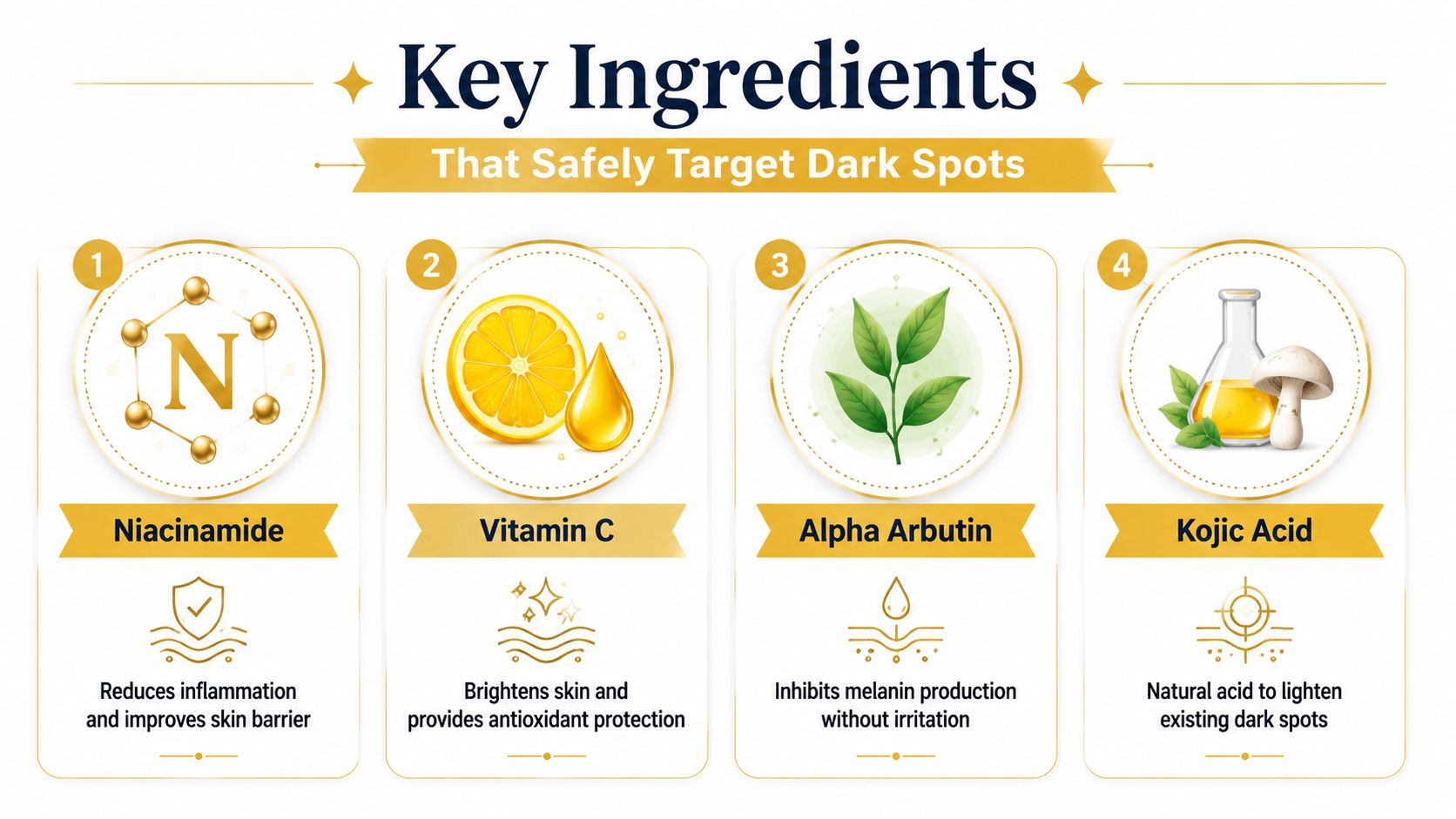
If you are comparing labels for pigmentation care, start with ingredients that can treat dark spots without pushing Indian skin into irritation. A strong formula is usually not the one with the longest ingredient list. It is the one with a few actives that have clear jobs, fit your skin's tolerance, and can be used consistently.
Niacinamide and vitamin C derivatives
Niacinamide is one of the easiest ingredients to tolerate. It supports the skin barrier, helps calm inflammation, and often fits well when pigmentation appears alongside acne, redness, or sensitivity. In practical terms, it helps quiet the signals that keep dark marks active.
Vitamin C derivatives, including vitamin C-rich botanical sources like Kakadu plum, suit skin that looks dull or uneven more than skin that feels actively irritated. They work by helping defend against oxidative stress and by supporting a brighter overall tone. For many Indian users, that makes them easier to place in a morning routine, especially when the goal is steady improvement rather than a harsh corrective feel.
Alpha arbutin, kojic acid, and tranexamic acid
Alpha arbutin is a lighter-touch brightening ingredient to look for if you want something focused on pigment without a harsh profile. It works on melanin formation in a more measured way than many stronger actives. Kojic acid is also used often in Indian clinical discussions, especially in the 1 to 2 per cent range cited in topical use, because it targets tyrosinase and helps slow pigment creation dermatologist-oriented pigmentation ingredient overview.
Tranexamic acid appears often in blend formulas because it can help interrupt the signalling linked to melasma and PIH. That makes it a useful partner ingredient rather than a solo solution. In Indian dermatology discussions, these actives are usually positioned as part of combination therapy plus sunscreen, and the same ingredient overview is a useful reference for that approach dermatologist-oriented pigmentation ingredient overview.
Bakuchiol and the patience factor
Bakuchiol is a reasonable option if you want an ingredient that supports renewal but feels gentler than many retinoid-based routines. It does not erase pigment quickly, and that slower pace is part of its value. Skin that marks easily often responds better to something it can tolerate day after day than to a stronger ingredient that causes repeated irritation.
A steady formula matters more than a dramatic one. If a product pairs a pigment-targeting active with barrier support and does not overload the skin with obvious irritants, it is usually a better long-term choice than an “instant glow” product that sounds impressive but is hard to keep using.
You can also use this guide to reading safer skincare labels to check whether a formula is built for regular use or for marketing hype.
Decoding Labels and Avoiding Risky Ingredients
The problem with pigmentation shopping in India is not a lack of options. It's the opposite. Amazon India alone shows over 6,000 pigmentation-cream results, and that kind of overload makes people more vulnerable to exaggerated claims and quick-fix language Amazon India pigmentation cream results.
What to ignore first
Skip anything that promises instant fairness, overnight whitening, or permanent removal. Pigmentation does not behave like that, especially on Indian skin where irritation can easily trigger a fresh round of dark marks. If a brand talks more about dramatic transformation than ingredient clarity, that's a sign to slow down.
Also be careful with formulas that bundle hydroquinone, tretinoin, and steroid combinations without medical supervision. Those products can have a place in a dermatologist-led plan, but they are not casual long-term skincare. If you're buying over the counter, safety and transparency matter more than intensity.
What a safer label looks like
A more trustworthy product usually keeps the ingredient list readable, identifies the key actives clearly, and doesn't depend on harsh fragrance-heavy positioning. If the product is meant for daily use, it should also feel compatible with a morning sunscreen and a simple evening routine.
You can also use this label guide on choosing safer products to spot the difference between marketing language and actual formulation logic.
Questions to ask before you buy
- Does it match my pigmentation type? PIH, melasma, and sun spots do not always need the same formula.
- Can I use it without stinging or peeling? If the answer is no, it may not be worth it.
- Will I wear sunscreen daily with it? Without that, pigment can return.
- Is this a beginner-friendly formula? A strong product is not helpful if you can't use it consistently.
A cream is only useful if it fits your routine and your skin can tolerate it. That's especially true in India, where recurring sun exposure and sensitivity can make overly aggressive products backfire.
Building Your Complete Pigmentation Fighting Routine

A single cream can help, but it can't do the whole job alone. Indian dermatologists tend to manage hyperpigmentation with combination approaches, with emphasis on sun protection, topical lightening agents, and maintenance that people can stick to long term nationwide survey of Indian dermatologists. That mirrors what works in real life, not what looks good on a product banner.
A simple four-step structure
Cleanse. Use a gentle cleanser that removes sweat, sunscreen, and pollution without stripping the barrier. If your skin gets tight after washing, your routine is already too harsh.
Treat. Apply your pigment-fighting serum or cream now. Choose one that matches your concern, whether that's niacinamide for calmer skin, alpha arbutin for gradual brightening, or a blend that your skin tolerates well.
Nourish. A barrier-supporting moisturiser helps you stay consistent because comfortable skin is easier to treat. Dry, irritated skin often becomes a cycle of starting and stopping products.
Protect. Sunscreen is essential. If UV exposure keeps stimulating pigment, the marks can darken again even while you're using a good active.
If you want a clearer explanation of why sunscreen belongs in every pigmentation routine, this guide to sunscreen and dark spots makes the logic easy to follow.
What consistency actually looks like
Consistency does not mean stacking five strong actives at once. It means using one well-chosen treatment, keeping irritation low, and staying with the routine long enough for the skin to respond. That approach fits Indian skin much better than harsh, fast, and unstable regimens.
A good routine should feel boring in the best possible way. The cleanser should be gentle, the treatment should be targeted, the moisturiser should support comfort, and the sunscreen should be applied every morning. If one step keeps making your skin angry, the plan needs adjusting, not more force.
If you want a routine that's built around Indian skin, daily wear comfort, and ingredient-led simplicity, explore GlowBareSkin. You'll find science-backed skincare designed to support even tone, barrier comfort, and consistent use without the harshness that often worsens pigmentation.