
In today's business environment, scattered information is a productivity killer. Teams waste countless hours searching for documents, asking repetitive questions, and reinventing processes that are already documented somewhere. A robust Knowledge Management System (KMS) transforms this chaos into a centralized, accessible source of truth. But not all platforms are created equal. Choosing the wrong one can lead to poor adoption and wasted resources, creating more friction than it resolves.
This guide cuts through the noise. We provide a detailed look at 12 diverse knowledge management system examples to help you make an informed decision. We will move beyond generic feature lists and marketing copy to offer a practical analysis of each tool.
Inside, you will find:
In-depth reviews of platforms like Documind, Confluence, and Notion.
Specific use cases for different teams, from legal professionals reviewing contracts to customer support teams managing SOPs.
An honest assessment of each system's strengths and limitations.
Each entry includes screenshots and direct links, giving you everything needed to evaluate which solution best fits your organization's unique requirements. Our goal is simple: to help you select a tool that truly empowers your team to find, share, and leverage collective intelligence effectively.
1. Documind
Documind establishes itself as a powerful, AI-driven knowledge management system example by transforming static document repositories into interactive knowledge bases. It specializes in processing vast collections of PDFs, allowing users to upload hundreds of documents at once and interact with them through natural language queries. This capability makes it an indispensable tool for organizations and individuals who rely heavily on document-based information, such as legal firms, research institutions, and corporate training departments.
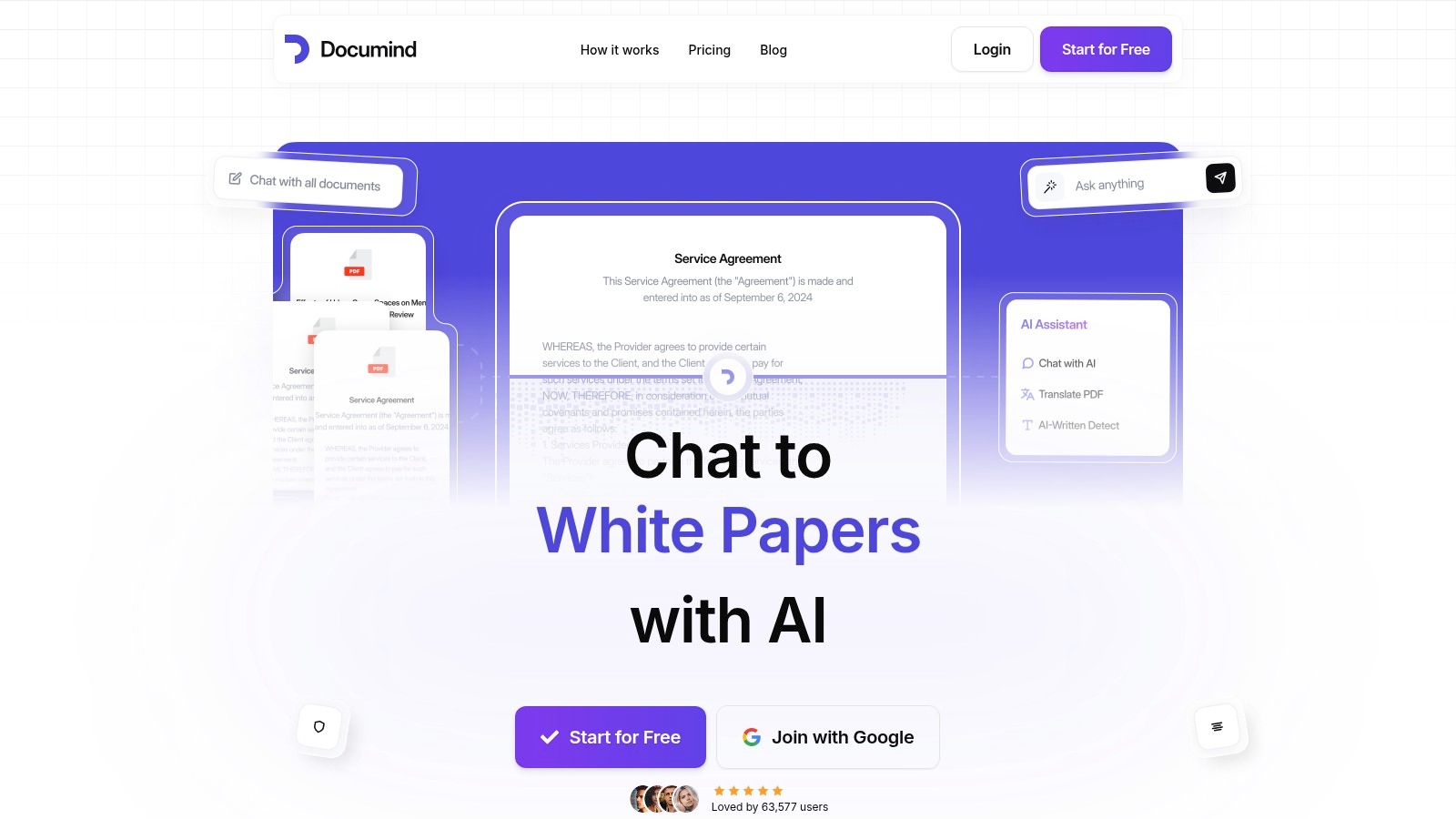
The platform’s core strength lies in its ability to synthesize information across multiple documents, providing cited answers and generating structured content like summaries, reports, and articles. This moves beyond simple document storage, creating a dynamic environment where knowledge is not just stored but actively utilized and expanded upon. The ability to create and embed custom chatbots trained on your specific document sets allows for the scalable distribution of knowledge, enabling teams to build internal helpdesks or customer-facing support tools without any coding.
Key Features & Use Cases
Bulk Document Analysis: Ideal for legal professionals conducting e-discovery or academic researchers performing literature reviews. Users can upload an entire case file or hundreds of research papers and instantly query the entire dataset for specific facts or themes.
Custom AI Chatbots: A support team can upload all their standard operating procedures (SOPs) and FAQs to create an internal chatbot. This bot can provide instant, accurate answers to new team members, reducing training time and improving consistency.
API & Integration: Developers can leverage the API to connect Documind’s document processing power to their existing applications, automating workflows like contract analysis or report generation within their native software environment.
Platform Breakdown
| Feature | Details |
|---|---|
| Best For | Legal, academic, and business teams needing to extract insights from large volumes of PDF documents. |
| Core Function | AI-powered Q&A, content generation, and chatbot creation from document collections. |
| Security | U.S.-hosted infrastructure, SSL/TLS encryption, and a strict policy against using customer data for AI training. |
| Pricing | Tiered plans available: Student ($9.93/mo), Professional ($14.93/mo), and Enterprise ($39.93/mo). |
| User Experience | Generally intuitive, though some users note minor areas for UI refinement. The core workflow is straightforward. |
| Unique Advantage | The ability to create shareable, no-signup-required chatbots from a document base, democratizing access to knowledge. |
Documind’s comprehensive feature set, combined with its strong security posture and versatile application, makes it a leading choice for anyone looking to build a modern knowledge management system. To delve deeper into the underlying concepts, explore Documind's guide on the evolution of the document management system.
Pros:
Rapid processing of thousands of PDFs, saving significant manual effort.
Natural language Q&A with citations across multiple languages and documents.
Robust collaboration tools and an API for deep system integration.
Cons:
Higher-tier plans can be a considerable investment for smaller teams.
The user interface, while functional, has some minor areas for improvement.
Website: https://documind.chat
2. Atlassian Confluence
Best for: Engineering, IT, and product teams embedded in the Atlassian ecosystem.
Atlassian Confluence is a powerful, long-standing knowledge management system example that excels at creating a deeply integrated single source of truth for technical and cross-functional teams. Its core strength lies in its tight integration with Jira, Bitbucket, and other Atlassian products, allowing teams to link project documentation directly to development tasks and tickets. This creates a seamless workflow where context is never lost.
The platform uses a system of "Spaces" (for teams or projects) and "Pages" (for documents), which can be organized into hierarchies. This structure, supported by powerful templates for meeting notes, project plans, and technical specs, helps maintain order. Real-time collaborative editing and inline comments make it an effective workspace for drafting documents. For larger organizations, the robust permission controls are a key benefit, enabling granular access management down to the individual page level.
While Confluence is incredibly powerful, its user interface can feel dense and complex without strong internal governance. New teams may experience a learning curve when setting up their space architecture.
Key Features: Page/space hierarchies, real-time co-authoring, advanced admin permissions, Atlassian Intelligence (AI), deep Jira integration, extensive app marketplace.
Pricing: Free plan for up to 10 users. Standard plans start at $6.05 per user/month. Premium and Enterprise plans unlock advanced features like analytics and unlimited storage.
3. Notion
Best for: Startups and SMBs looking for a highly flexible, all-in-one workspace and knowledge hub.
Notion has redefined the modern document by blending notes, tasks, wikis, and databases into a single, unified workspace. Its primary advantage is its unparalleled flexibility; users start with a blank canvas and can build a comprehensive knowledge management system using modular "blocks." This approach makes it incredibly fast to set up a centralized hub for everything from company policies and SOPs to project roadmaps and meeting notes.
The platform's database feature is a standout, allowing teams to create interconnected tables with different views (like Kanban, calendar, and gallery). This transforms static documents into dynamic tools for tracking projects and information. Its clean, minimalist interface is highly approachable, and for those who don't want to start from scratch, a rich ecosystem of community-built templates provides a significant head start. For a closer look at implementation, you can learn more about how to build a knowledge base with Notion.
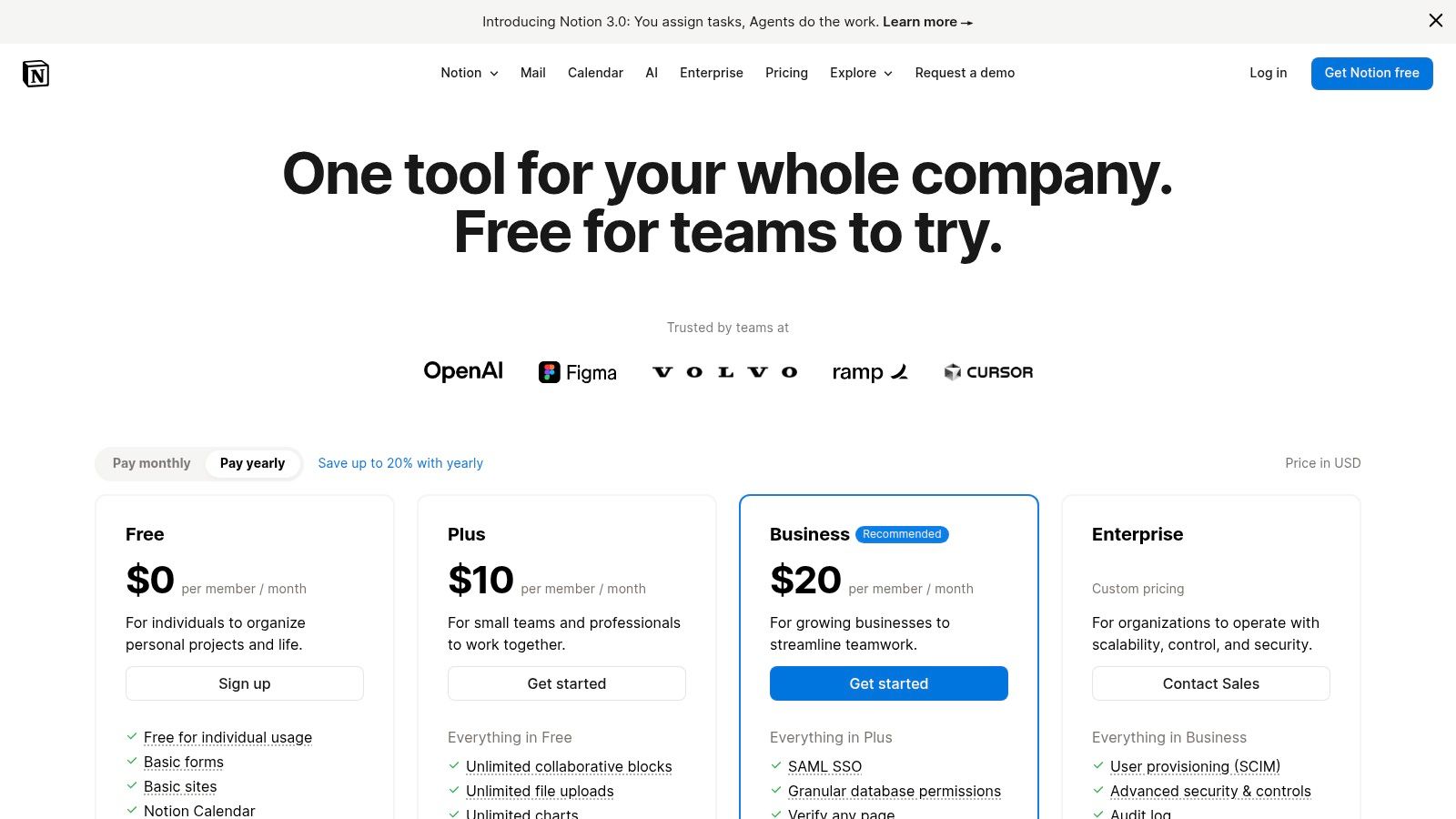
While Notion's flexibility is a major asset, it can also be a weakness. Without strong internal governance and clear guidelines, a Notion workspace can become disorganized at scale. Advanced controls and security features like single sign-on (SSO) are reserved for its higher-tier plans.
Key Features: Flexible pages and databases, relational data linking, multiple database views (Kanban, gallery, list, calendar), Notion AI, extensive template library, real-time collaboration.
Pricing: Free plan for individuals. Plus plans start at $10 per user/month. Business and Enterprise plans add advanced admin controls, SSO, and more robust security.
Website: https://www.notion.com/pricing
4. Guru
Best for: Revenue-generating teams (sales, support, success) needing verified, bite-sized answers directly within their existing workflows.
Guru is an AI-powered knowledge management system example that excels at delivering trusted information where and when employees need it. Its core strength is its verification workflow, which requires knowledge owners to regularly review and update content, ensuring accuracy. This creates a "single source of truth" that teams can rely on, reducing the time spent searching for or second-guessing information. The platform's browser extension and deep integrations with apps like Slack, Microsoft Teams, and Zendesk are central to its value, allowing users to access and share knowledge without switching context.
The platform uses a "Card" structure for digestible pieces of knowledge, making it easy to consume information quickly. Guru's Private AI Search lets users ask natural language questions and receive direct answers synthesized from verified company content, rather than just pointing to a document. While this "answer-first" approach is highly efficient for fast-paced teams, the AI credit model can introduce complexity for administrators managing usage.
Key Features: Verification workflows, Private AI search and chat, browser extension, integrations with Slack/Teams/Salesforce, usage analytics, SOC 2 Type 2 compliance.
Pricing: Free plan for up to 3 users (read-only for more). Builder plans start at $12 per user/month (5-seat minimum). Enterprise plans offer advanced features.
Website: https://www.getguru.com/pricing
5. Zendesk Guide
Best for: Customer service teams looking for a knowledge base that is seamlessly integrated with their support ticketing system.
Zendesk Guide is a knowledge management system example built specifically for customer self-service and support agent efficiency. Its primary strength is its native integration within the broader Zendesk support suite. This allows support agents to easily search for and link help articles directly within tickets, creating a streamlined workflow that reduces response times and ensures consistent answers. The platform excels at creating public-facing help centers that can deflect common inquiries before they become tickets.
The system is designed for managing customer-facing content, offering features like customizable themes, article versioning, and content lifecycle management. Analytics provide deep insights into what customers are searching for, which articles are most effective, and where knowledge gaps exist. This data-driven approach helps teams continuously improve their support documentation. While it's powerful for external-facing knowledge, using it as a purely internal wiki can be less intuitive than other dedicated platforms.
Key Features: Public help centers, WYSIWYG editor, AI-powered tools for content creation and suggestions, deep integration with Zendesk tickets and bots, robust analytics and reporting.
Pricing: Included in Zendesk Suite plans, which start at $55 per agent/month.
Website: https://www.zendesk.com/pricing/
6. Help Scout
Best for: Customer-facing teams seeking an integrated knowledge base and help desk solution.
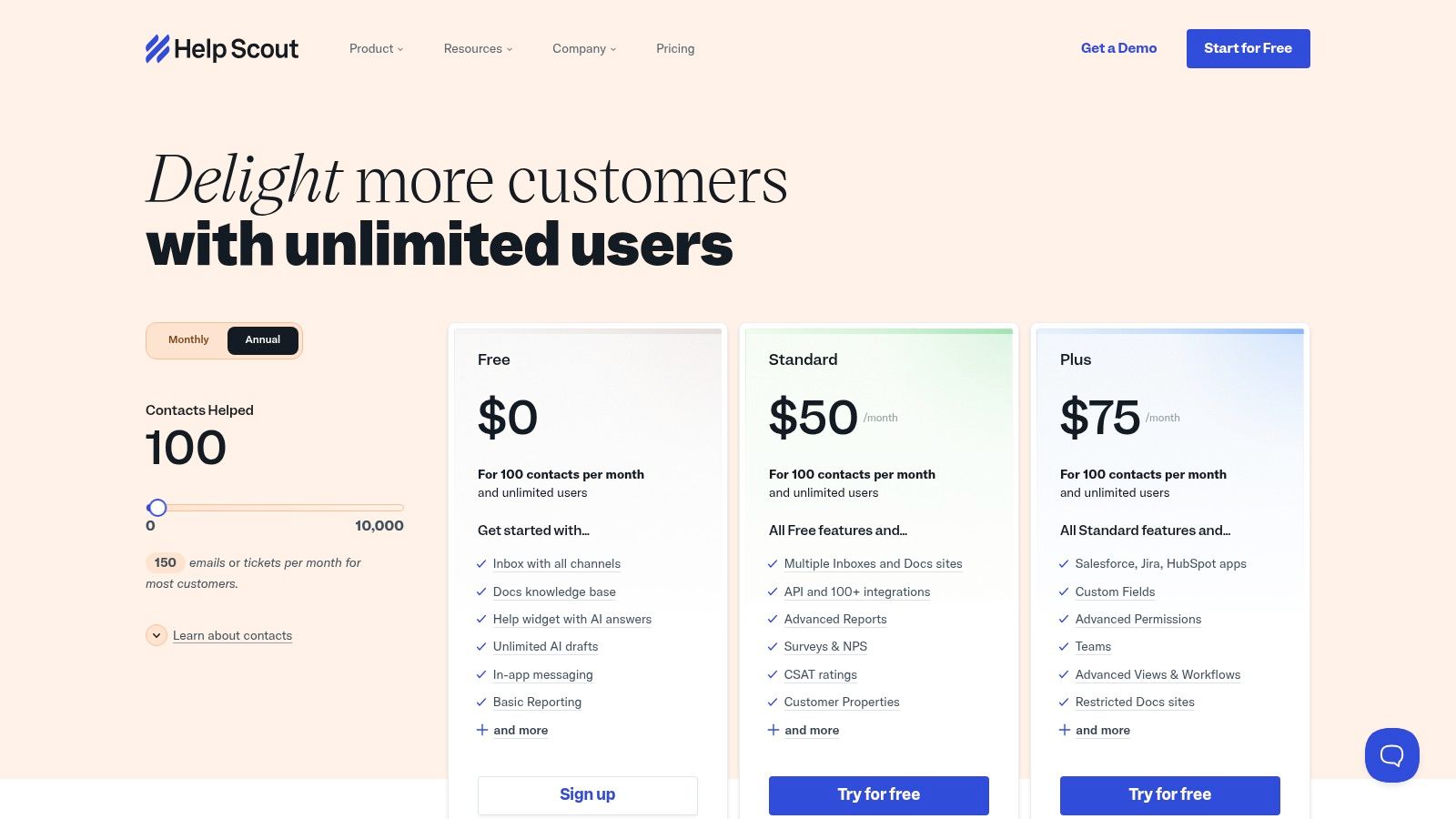
Help Scout carves out a unique niche by bundling a powerful knowledge base (Docs) directly with its customer communication platform. This integration makes it an excellent knowledge management system example for support and success teams who need to create, manage, and share information both internally with colleagues and externally with customers. The platform's standout feature is its pricing model, which offers unlimited users on paid plans, making it highly predictable and scalable for growing teams.
The platform focuses on simplicity and effectiveness. Users can quickly create public or private help centers with custom branding and domains. The "Beacon" feature allows you to embed your help articles directly on your website or app, and its AI can suggest articles to users, deflecting common support tickets. While it excels at straightforward documentation and support workflows, its enterprise-level controls and complex organizational hierarchies are less extensive than those found in larger, dedicated suites.
Key Features: Integrated knowledge base and help desk, Beacon embeddable widget with AI answers, article ratings and reports, public and private collections, unlimited users on paid plans.
Pricing: Standard plan starts at $25 per user/month (billed monthly, minimum 2 users). A Plus plan unlocks more Docs sites and advanced features.
Website: https://www.helpscout.com/pricing/
7. Document360
Best for: Creating sophisticated public-facing help centers and private internal knowledge bases with strong governance.
Document360 is a dedicated knowledge base platform designed from the ground up to manage both customer-facing and internal documentation. Unlike more general-purpose wikis, it excels in structured content creation, offering advanced authoring tools, version control, and multi-language support. This makes it a prime example of a knowledge management system for teams that need to maintain high-quality, consistent documentation for products or services.
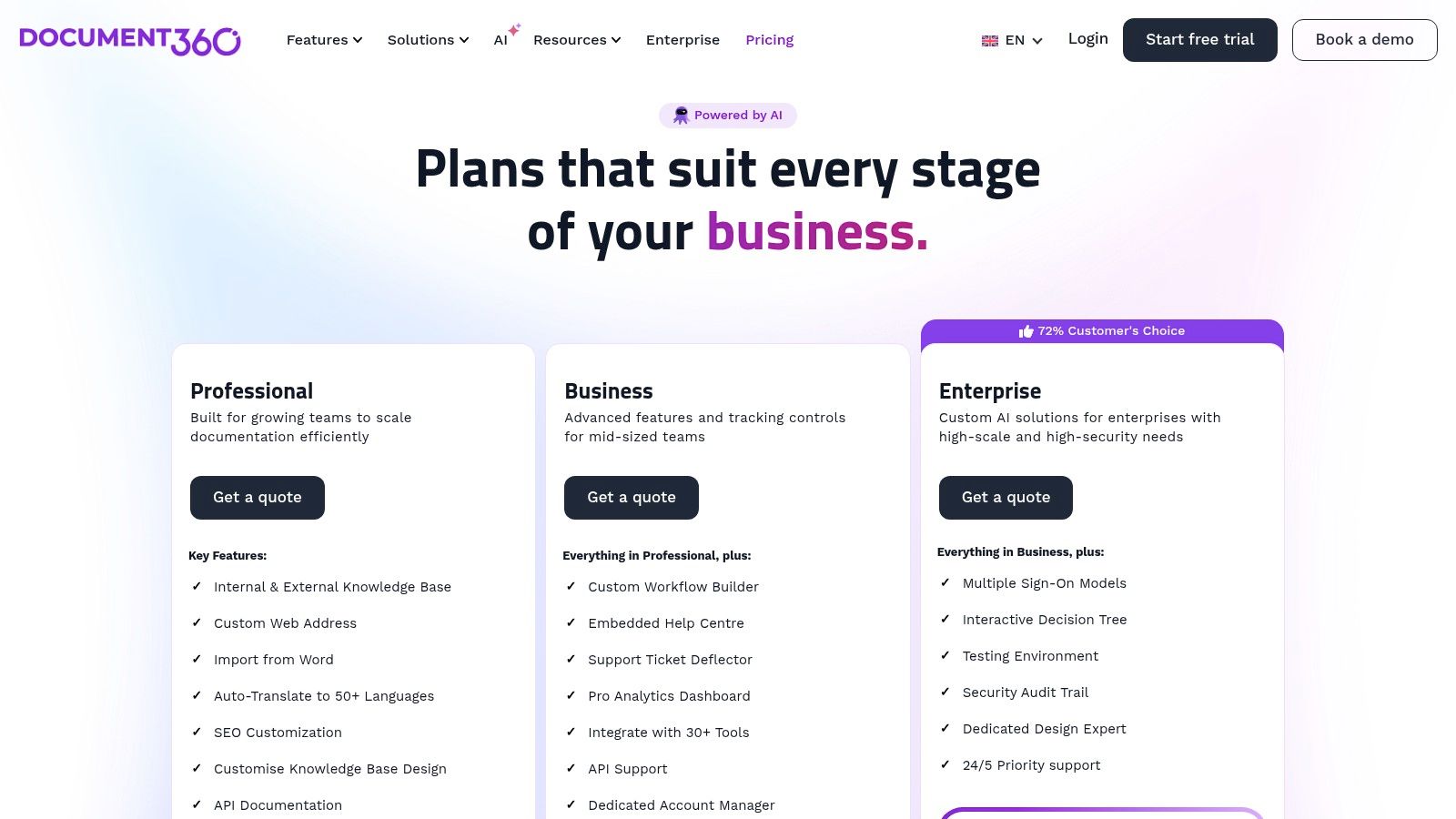
The platform's strength lies in its powerful feature set geared toward formal documentation. Its AI-powered capabilities, including an AI writing assistant and an intelligent search function, enhance both content creation and user discovery. The workflow and analytics features provide teams with the tools needed to manage the entire content lifecycle, from drafting and review to publication and performance tracking. For organizations requiring robust security, Document360 offers enterprise-grade options like SSO and advanced permissions. While powerful, its implementation can be more involved than simpler tools, and its pricing is not publicly listed.
Key Features: Public/private knowledge bases, AI writing assistant and search, multilingual support, version control, content workflows, analytics, enterprise-grade security.
Pricing: Standard plans start at $199 per project/month. Business, Enterprise, and Enterprise Plus plans with more advanced features are available with custom pricing.
Website: https://document360.com/pricing/
8. Bloomfire
Best for: Large enterprises seeking to centralize knowledge and encourage engagement through an AI-powered Q&A format.
Bloomfire is an enterprise-grade knowledge management system example designed for deep content indexing and discoverability. It excels at making disparate information searchable, automatically transcribing and indexing text from video and audio files, which sets it apart for companies with rich media assets. The platform’s core is a powerful AI-driven search that helps employees find precise answers quickly, rather than just pointing them to documents.
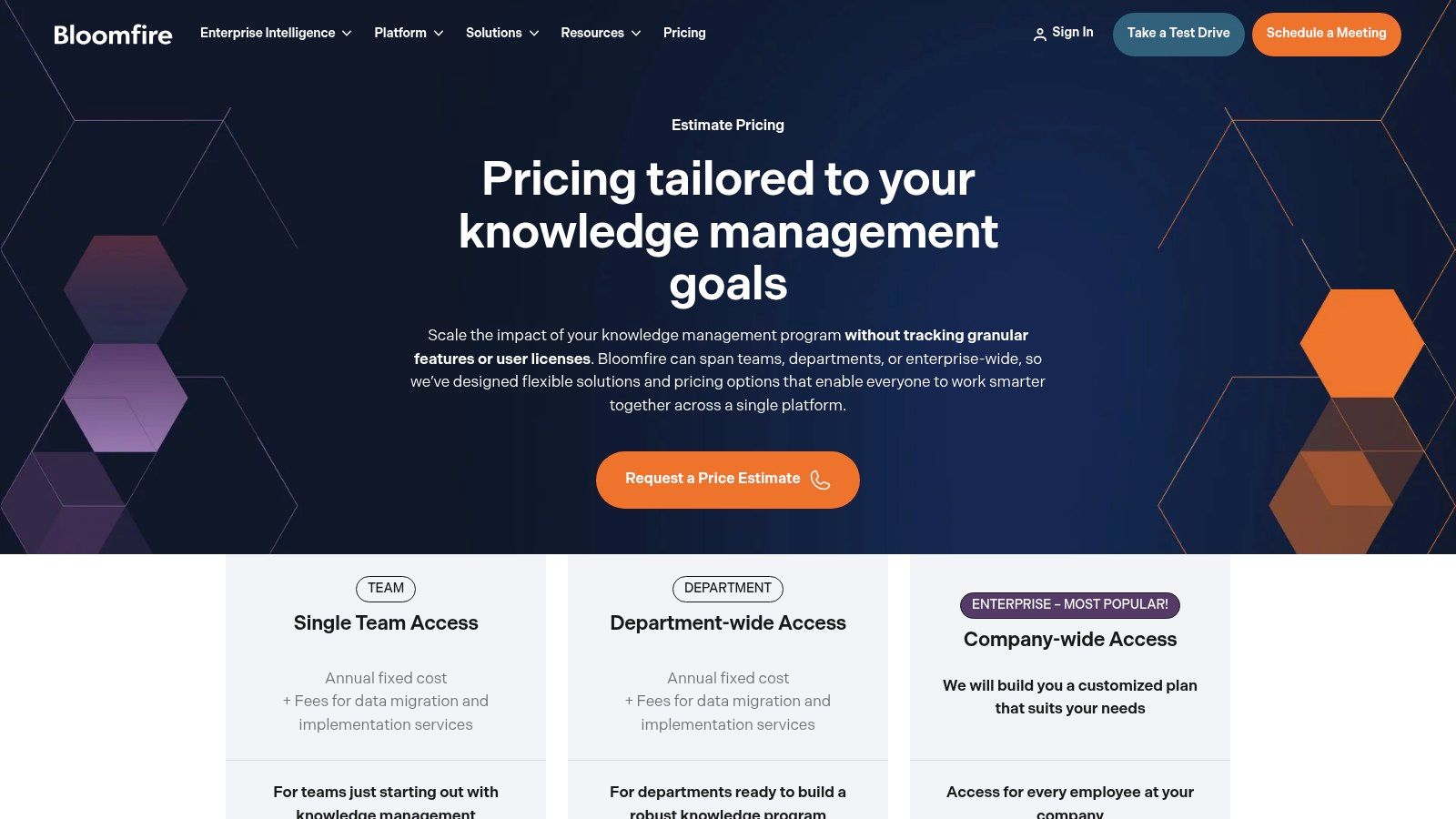
Its Q&A engine and community structure foster an interactive environment where subject matter experts can directly answer questions, creating a crowd-sourced, evergreen FAQ. This makes it ideal for customer support and sales enablement teams who need fast, verified answers. While powerful, its structure benefits from dedicated content curation and management to prevent information sprawl. Its flat-rate pricing model is also a significant advantage for large organizations looking to scale without per-user cost increases.
Key Features: AI-powered federated search, video/audio content indexing, Q&A engine, content engagement analytics, customizable branding, SOC 2 Type II compliance.
Pricing: Custom pricing based on business needs. Not priced per user, but requires annual or multi-year contracts arranged through their sales team.
Website: https://bloomfire.com/pricing
9. Slab
Best for: Startups and SMBs looking for a beautifully designed, modern internal wiki that prioritizes speed and simplicity.
Slab positions itself as a "knowledge hub for the modern workplace," and it delivers on that promise with a clean, intuitive interface that feels more like a blog than a traditional wiki. Its core strength lies in its simplicity and focus on content creation and discovery, making it an excellent knowledge management system example for teams that need to get up and running quickly without a steep learning curve. The platform is designed to unify information from various sources.
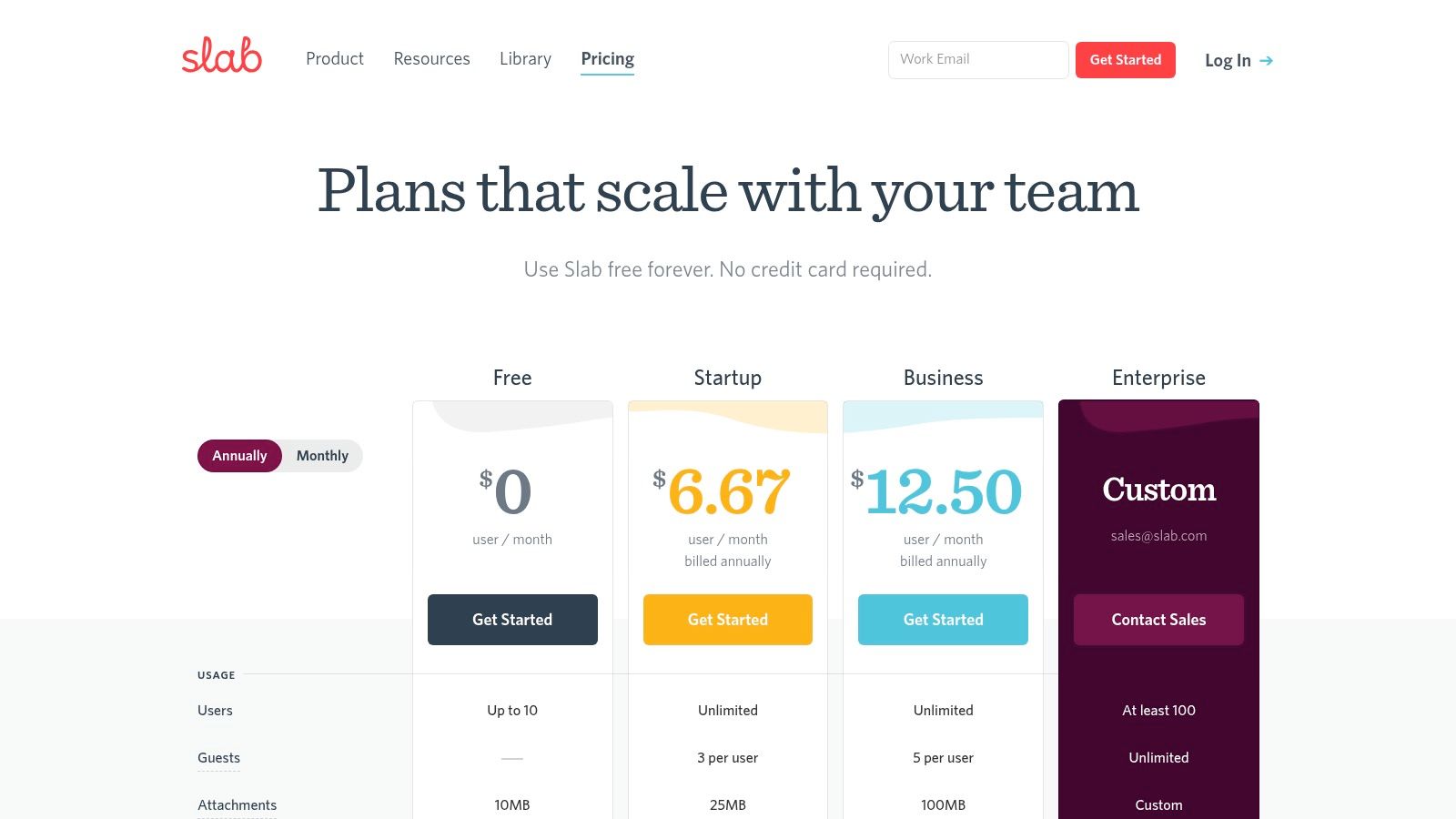
The standout feature is its Unified Search, which lets users search not only within Slab but also across integrated apps like Slack, Google Drive, and Asana from a single search bar. Slab organizes content into "Topics" (folders) and "Posts" (documents), with useful features like content verification to ensure information stays current. Its AI features, such as AI Ask and Autofix, further streamline knowledge creation and access. While it excels as an internal wiki, its functionality as an external-facing help center is limited, and it has fewer enterprise-grade add-ons compared to larger suites.
Key Features: Unified Search across integrated tools, "Posts" and "Topics" organization, content verification, AI Ask and Autofix, templates, SAML SSO and SCIM on higher tiers.
Pricing: Free plan for up to 10 users. Startup plans start at $8 per user/month, with Business and Enterprise plans available for advanced features and larger teams.
Website: https://slab.com/pricing/
10. Tettra
Best for: Small to medium-sized businesses looking for a simple, chat-integrated internal wiki.
Tettra is an excellent knowledge management system example designed to live where your team works: inside Slack and Microsoft Teams. It functions as a lightweight internal wiki, prioritizing the quick capture and retrieval of answers to common questions, standard operating procedures, and company policies. Its core strength is the seamless integration that allows users to search for and share Tettra pages directly within chat, reducing context switching and encouraging documentation adoption.
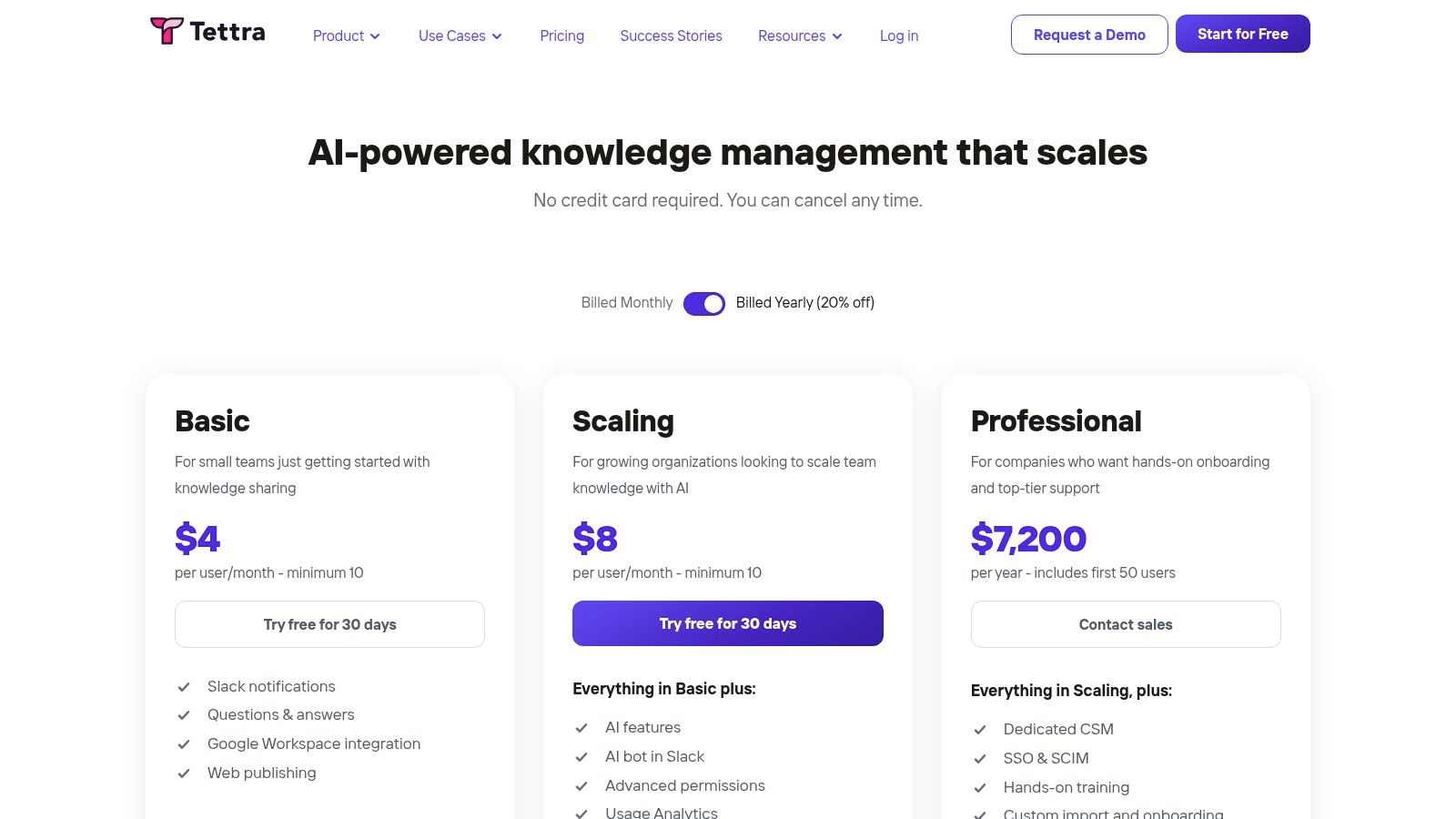
The platform’s standout feature is its page verification workflow. Content owners are automatically reminded to review and update their pages, ensuring that the knowledge base remains accurate and trustworthy over time. This simple but effective system tackles the common problem of stale documentation head-on. While Tettra excels at internal knowledge sharing, its capabilities are less suited for building complex, external-facing customer help centers. For chat-centric teams, its simplicity and verification model make it a very fast and effective solution.
Key Features: Deep Slack and MS Teams integration, content verification workflows, page ownership, simple editor, analytics on content usage, and external sharing.
Pricing: Scaling plan starts at $10 per user/month (with a 10-user minimum). A more feature-rich Enterprise plan is available with custom pricing.
Website: https://tettra.com/
11. KnowledgeOwl
Best for: Customer support and product teams needing a highly customizable, standalone public or private knowledge base without complex per-user pricing.
KnowledgeOwl is a dedicated knowledge base platform that excels at creating clean, user-friendly help centers and documentation sites. Its primary differentiator is its focus on deep customization and straightforward, flat-rate pricing, making it an attractive knowledge management system example for companies that want brand consistency without unpredictable costs. Teams can control the look and feel using custom HTML, CSS, and JavaScript, or use intuitive theme editors for quick adjustments.
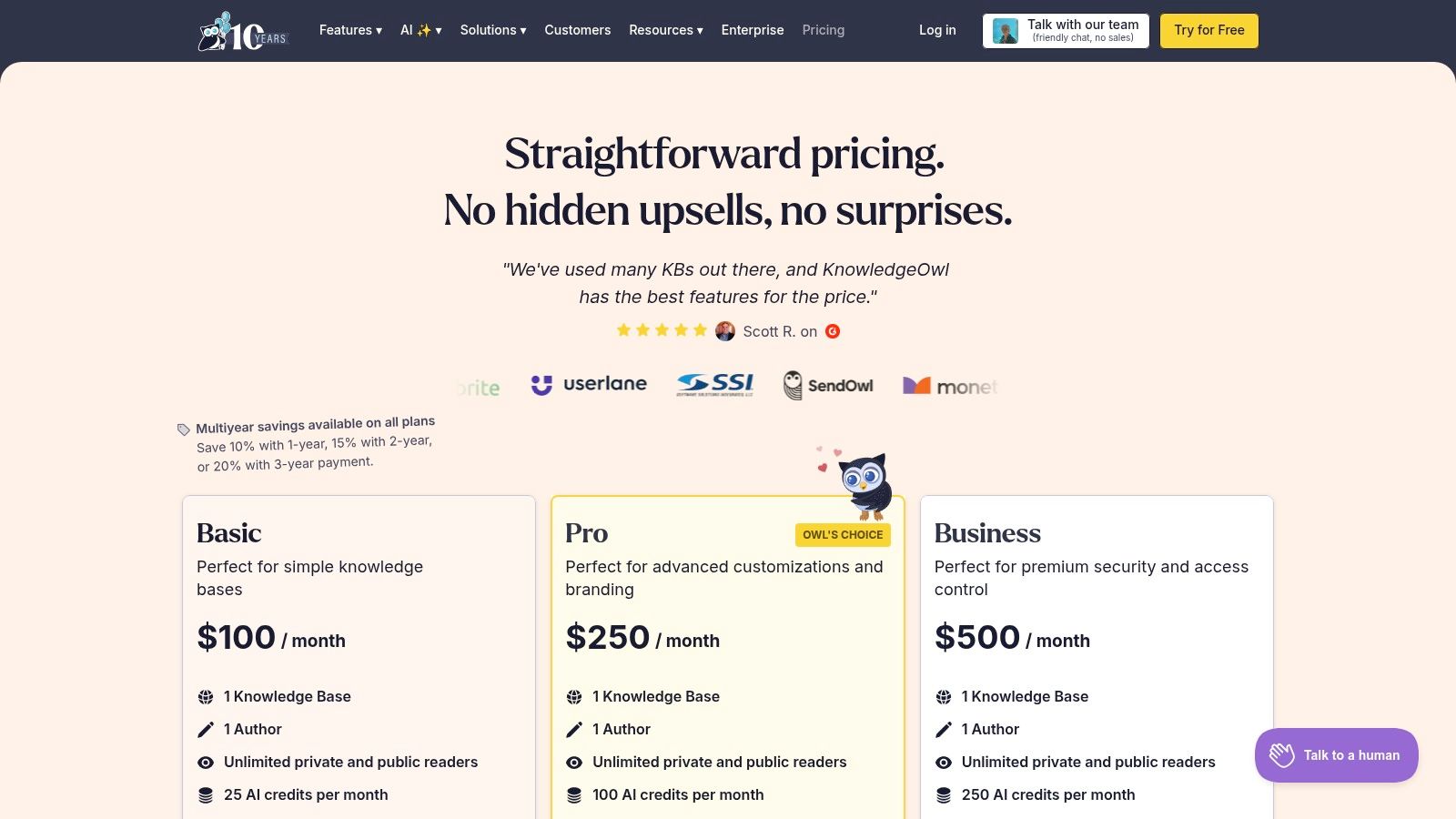
The platform is purpose-built for documentation, not internal collaboration like Confluence or a full helpdesk like Zendesk. It offers robust features for managing content, including version history, reader feedback mechanisms, and detailed analytics to see which articles are most effective. The recent addition of Owl Intelligence introduces AI-powered search and a trainable chatbot, allowing users to get answers conversationally directly from the knowledge base content. While its ecosystem is smaller, its specialization and strong customer support make it a powerful choice for its intended use case.
Key Features: Custom HTML/CSS/JS theming, Owl Intelligence AI features and chatbot, public and private knowledge bases with SSO, reader analytics and feedback, versioning, developer API access.
Pricing: Plans are based on the number of knowledge bases and authors, not end-users. Flex plan starts at $99/month for one knowledge base and one author.
Website: https://www.knowledgeowl.com/pricing
12. Microsoft SharePoint (SharePoint Online)
Best for: Organizations deeply integrated into the Microsoft 365 ecosystem that need a highly customizable intranet and document management backbone.
Microsoft SharePoint serves as the foundational content management layer for many organizations using Microsoft 365. It's less of an out-of-the-box wiki and more of a powerful toolkit for building internal knowledge hubs, team sites, and document repositories. Its strength lies in its native integration with Teams, OneDrive, and the wider Office suite, creating a cohesive environment where documents and collaborative spaces are intrinsically linked. This makes it a ubiquitous knowledge management system example in the corporate world.
The platform enables the creation of "Sites" and "Pages" with granular permissions, version history, and robust governance controls, which is critical for compliance in large enterprises. While it is incredibly powerful, achieving a polished, user-friendly knowledge base often requires significant setup effort and a clear governance strategy. The best results typically involve leveraging other Microsoft services, like Viva and Search, to enhance the end-user experience. For a deeper dive into effective implementation, you can explore some knowledge management best practices for success.
Key Features: Team sites and pages, document libraries with versioning, deep Microsoft 365 integration, enterprise-grade security and governance, powerful search capabilities.
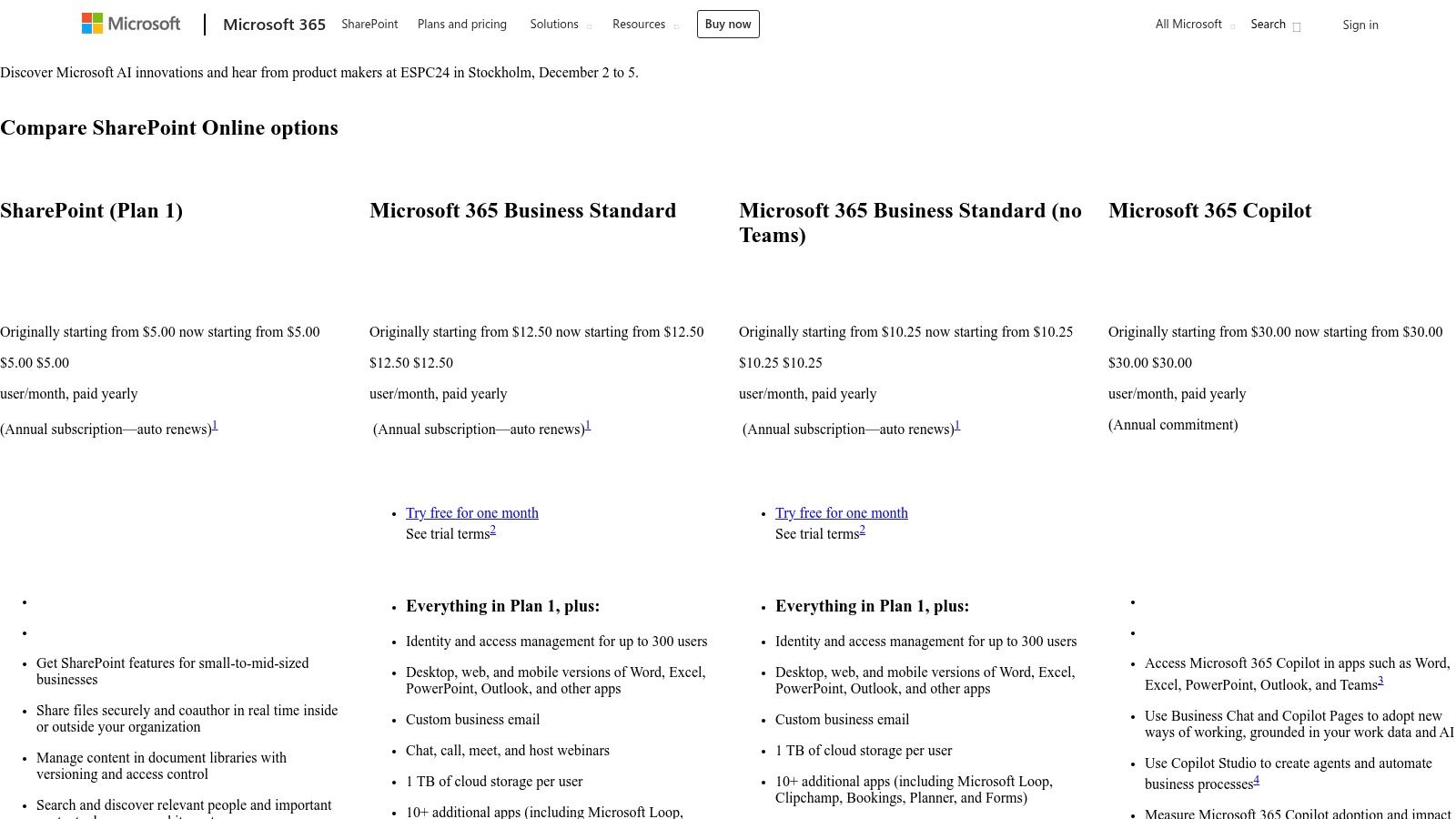
Pricing: Included with most Microsoft 365 Business and Enterprise plans. Standalone plans start at $5.00 per user/month.
Website: https://www.microsoft.com/en-us/microsoft-365/sharepoint/compare-sharepoint-plans
Top 12 Knowledge Management Systems Comparison
| Platform | Core Features/Capabilities | User Experience & Quality ★ | Value & Pricing 💰 | Target Audience 👥 | Unique Selling Points ✨ |
|---|---|---|---|---|---|
| Documind 🏆 | Bulk upload hundreds of PDFs, multilingual Q&A, chatbot training | ★★★★★ Fast, precise, multi-doc chat | $9.93-$39.93/mo tiers, scalable plans | Students, professionals, enterprises | AI-powered PDF chat + embed widgets + strong security |
| Atlassian Confluence | Page/space hierarchies, real-time co-authoring, Atlassian AI | ★★★★ Robust but complex interface | Free tier + Premium/Enterprise plans | Engineering & cross-functional teams | Deep Jira integration, large-scale governance |
| Notion | Flexible pages/databases, AI writing, rich templates | ★★★★ Intuitive & highly customizable | Free + paid bundles | SMBs, startups, knowledge workers | All-in-one workspace with broad integrations |
| Guru | Verified wiki, AI search/chat, Slack/CRM integrations | ★★★★ Strong governance & answer accuracy | Tiered pricing, AI credits | Support, sales, ops teams | “Answer wherever you work” AI & verification |
| Zendesk Guide | Public help centers, article management, ticket linking | ★★★★ Customer self-service focused | Part of Zendesk Suite, per agent pricing | Customer support teams | Omnichannel support + AI tools + mature ecosystem |
| Help Scout | Hosted help centers, AI answers, embeddable widgets | ★★★★ Simple setup, article analytics | Contact-based pricing, unlimited users | Growing teams & SMBs | Contact-based pricing + internal/external AI docs |
| Document360 | Product docs focus, AI writing/search, multilingual | ★★★★ Purpose-built knowledge base | Quote-based pricing | Product & customer support teams | Strong governance + AI + extensive integrations |
| Bloomfire | AI search/authoring, Q&A engine, multi-community setup | ★★★★ Enterprise-grade admin & security | Annual contracts, custom pricing | Large enterprises | AI-driven deep indexing + enterprise governance |
| Slab | Internal wiki, AI helpers, unified search | ★★★★ Clean UI, fast rollout | Competitive SMB pricing | SMBs, startups | Simple UX + AI Ask + guest access |
| Tettra | Slack/Teams integration, verification workflows | ★★★ Quick adoption for chat-centric teams | Pricing varies, sales contact | SMBs, chat-focused teams | Verification model + chat integration |
| KnowledgeOwl | Public/private KB, deep theming, AI chatbot | ★★★★ Fixed pricing, strong theming | Fixed pricing tiers | Support & technical writers | Advanced theming + Owl Intelligence chatbot |
| Microsoft SharePoint | Team sites, pages, lists, Microsoft 365 integration | ★★★★ Familiar for MS 365 users | Included in MS365 bundles | Enterprises with MS365 | Built-in MS ecosystem + extensive governance |
Making Your Final Decision: From Examples to Implementation
Navigating the landscape of knowledge management system examples can feel overwhelming, but the diverse options presented in this article highlight a crucial truth: the perfect system is the one that fits your unique workflow, not the other way around. We've explored everything from the structured, enterprise-ready environments of Atlassian Confluence and Microsoft SharePoint to the flexible, all-in-one workspaces offered by Notion. We've also seen how customer-centric platforms like Zendesk Guide and Help Scout excel at external knowledge sharing.
The key takeaway is to move beyond a simple comparison of features. Instead, focus on the specific problems you need to solve. Is your primary challenge organizing internal documentation for a growing development team? Tools like Slab or Tettra might be ideal. Is your goal to empower a customer support team with instant, accurate answers? Document360 or Guru are built for that purpose. Or, is your team drowning in a sea of dense documents like legal contracts, academic papers, or technical manuals? This is where specialized AI-powered tools like Documind create a new category of value, transforming static files into interactive knowledge sources.
Actionable Steps to Choosing Your KMS
Selecting the right platform requires a strategic approach. Rather than making a decision based on marketing materials alone, follow these steps to ensure you choose a tool that your team will actually adopt and benefit from.
Identify Your Core Use Case: Start by defining the most critical pain point. Are you centralizing SOPs, managing project documentation, or enabling complex research? Your primary goal will immediately narrow down the list of relevant knowledge management system examples. For instance, a legal team's needs are vastly different from a customer support team's.
Consider Your Content Types: Evaluate the kind of information you manage. If your knowledge base is primarily composed of lengthy, unstructured documents (PDFs, DOCX, reports), a system with powerful AI-driven search and summarization, like Documind, is essential. If it's mostly short-form, collaborative articles, a wiki-style platform like Confluence or Notion might suffice.
Run a Pilot Program: Never underestimate the power of a hands-on trial. Shortlist two or three top contenders from our list and assign a small, representative group of users to test them in a real-world scenario for a week or two. Gather direct feedback on usability, integration with existing tools (like Slack or Jira), and overall effectiveness. This practical test will reveal nuances and deal-breakers that you can't see in a demo.
Ultimately, the goal is to build your organization's collective brain. The right tool will not only store information but also make it accessible, actionable, and intelligent. By carefully evaluating your needs against these diverse examples and running a thoughtful pilot, you can confidently implement a system that transforms knowledge from a static asset into your most powerful competitive advantage.
Ready to unlock the knowledge trapped in your documents? Many of the knowledge management system examples we covered help organize information, but Documind lets you have a direct conversation with it. Turn your static PDFs, reports, and manuals into an interactive AI chat experience by visiting Documind to start your free trial.